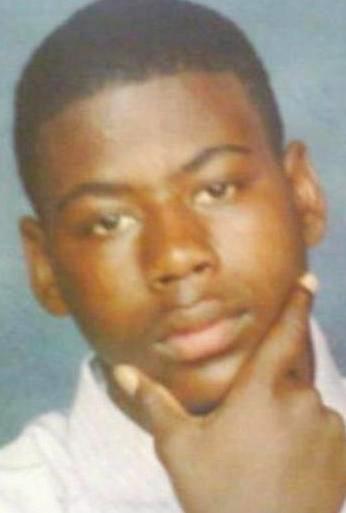
Laquan Allen was a 14-year-old boy with a bright smile and a deep love for basketball. An eighth-grader at McNair Elementary School in Chicago, he dreamed of one day playing professionally. His family, including his mother, Luciana Sanders, and grandmother, Dieanna Ward, remember him as a good kid who was playful and friendly. He lived in the West Humboldt Park neighborhood with his mother, grandmother, and 90-year-old great-grandmother. Laquan was known for his joking nature and for being affectionate, always giving his mother and grandmother kisses. On the morning he died, he kissed them both goodbye before leaving home. "That’s what he like to do, is smile," his mother recalled while looking at his school picture.
The vibrant life of Laquan, a Black teenager, was cut short on the afternoon of Saturday, March 25, 2017. Just after 3 p.m., he was on a sidewalk in the 4900 block of West Hubbard Street in the Austin neighborhood, near Hubbard Playlot Park. According to Chicago Police, a vehicle approached and someone inside opened fire. Laquan was struck by a bullet in the buttocks. A nearby resident reported hearing three gunshots. This was the second time in less than two years that Laquan had been shot; he had survived a shooting to his thigh the previous year. The area was known for violence, and the block where he was killed had seen numerous shootings in the years prior.
Paramedics transported Laquan to Mount Sinai Hospital. Police initially reported that his condition had been stabilized, but his injury proved to be fatal. He was pronounced dead at the hospital at 3:34 p.m. His grandmother was the first to hear that something was wrong when one of Laquan's teachers called her. She and Laquan's mother began a frantic search, calling hospitals until they located him at Mount Sinai, where they were given the devastating news of his death.
The Chicago Police Department's Area North detectives began an investigation at the scene. In the rain, police officers taped off the area adjacent to the park, which was surrounded by homes with boarded-up windows. Evidence markers dotted the pavement as investigators worked to piece together what happened. Police searched for the shooter and the vehicle involved, but no detailed descriptions were immediately released to the public. Investigators did not officially comment on a motive or whether they believed Laquan was the intended target.
In the wake of the shooting, Laquan’s family was overwhelmed with grief and questions. His mother and grandmother believed he had been facing peer pressure to join a gang and that the shooting was targeted. They acknowledged he had been in some trouble before, for stealing a car, but insisted he was not a bad person. "He wasn't no bad kid," his grandmother said. "He likes to do what others do and we speak to him about this. We speak to him about this every day, every month, every chance we get, ‘please stop.’" His mother made a public plea for the person responsible to take accountability. "Whoever it is that killed my son, they need to come forward," she said. "Even if it was an accident, just please come forward and say that you done it … My son did not deserve this."
Laquan Allen's death was one of several homicides during a violent weekend in Chicago that saw three people killed and nearly 30 others wounded. His grandmother said the family had been trying to move out of the city to protect themselves from such violence. "We live it every day," she said. "We know that something will happen to our babies, our children." She mourned the future she would never have with her grandson, saying, "It’s hard knowing that I won’t see him come through the door tonight."
The investigation into Laquan Allen's murder is ongoing. As of the most recent reports, no arrests have been made, and his case remains unsolved. His family continues to seek justice for the loss of a boy remembered for his love of family, his playful spirit, and a smile that could light up a room.