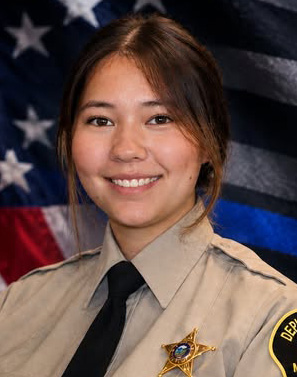
Naomi Kathleen Cheney was a studious and athletic young woman, described by her father as “jolly yet serious at any sort of work.” An Alabama native and recent college graduate, she had briefly taught high school before deciding to do her part for the war effort. She joined the Women's Army Corps (WAC), earning an officer's commission in the summer of 1943. That September, the 25-year-old Second Lieutenant, a petite brunette, was transferred to the Army Air Forces Technical School in Sioux Falls, South Dakota. Her father, Frank E. Cheney, a veteran of World War I, remembered his daughter as energetic, venturesome, and careful, saying, “She loved the WAC and the army.”
On the evening of Tuesday, October 5, 1943, Lt. Cheney visited her roommate at the base hospital. Around 9:00 p.m., she prepared to walk back to her home at 525 South Euclid Avenue. New to the area, she paused at Gate No. 3 and asked the guard if it was safe to walk home alone.
The guard told her to use her own judgment. Cheney decided to proceed, likely taking a shortcut along the railroad tracks. She was never seen alive again. When she failed to report for duty the next morning, military police conducted a routine search but found no trace of her.
Later that afternoon, a 10-year-old girl named Val Rae was playing near a ravine by the railroad tracks when she discovered Cheney’s body. The child ran to get her friends before they alerted their parents, who called the police. Cheney was found lying face-up in a weedy hollow beneath a viaduct near 12th Street and Grange Avenue, less than three blocks from her home. She had been brutally beaten to death with a blunt object, her skull crushed. A contemporary newspaper report described a horrific scene: "One side of the face reddened by a hemorrhage, the hair matted with dried and darkened gore, one eye sealed shut and the ears, nostrils and mouth filled with caked blood." There was no evidence of robbery, as cash was still in her purse, nor of sexual assault.
The investigation was initially handled by the military before being turned over to the Sioux Falls Police Department on October 10. The immediate police response was criticized in later years for having trampled the scene, potentially destroying evidence. Investigators found Cheney's cap, flight hat, and purse nearby. The Army launched what was called the “greatest mass examination in history,” checking the hands of 40,000 soldiers and forcing several thousand to strip for examination of their bodies. The most significant clue was a trail of blood leading from the murder site to a tourist cabin less than 50 feet away.
The cabin's resident, a 31-year-old transient farm laborer, was arrested. Blood was found inside and outside his cabin and on his shoes. The blood type matched Cheney's, but the rudimentary forensic testing of 1943 could not definitively prove it was hers. The suspect claimed he had accidentally stepped in the blood, but investigators noted its presence on top of his boots contradicted his story. Lacking sufficient evidence to prosecute, authorities were forced to release him. The man, who was never publicly identified, was later killed while serving in World War II. Police officials in later years expressed confidence that with modern DNA technology, they would have been able to indict him.
In the days following his daughter's murder, Frank Cheney enlisted in the U.S. Navy. "I am going to do my best to fill a niche in the armed services, a niche that Kathleen filled while she lived," he told reporters. "She would want it that way." The Minnehaha County sheriff announced a $500 reward for information leading to the killer's capture, but the case grew cold. For years, the crime haunted the city, with a 1945 newspaper article noting, “An eerie hush still grips the gloomy, forbidding dell, and a mocking wind sighs through the gnarled trees and brush that imprison a shocking secret.”
The murder of Naomi Kathleen Cheney is recognized as the oldest unsolved homicide in the history of Sioux Falls. As of July 2023, the Sioux Falls Police Department confirmed it remains one of only three unsolved murder cases in the city. Though officially considered an open case, it is inactive. Nearly 82 years of silence have passed, and the secret of who took the young lieutenant's life remains hidden within the desolate ravine where she took her last walk home.