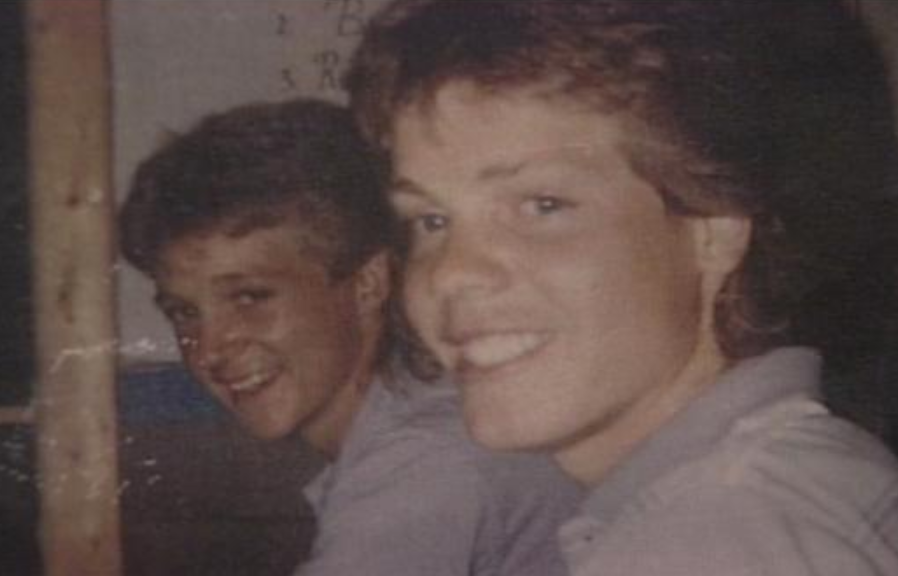
Kevin Ives was a 17-year-old boy from a close-knit community in central Arkansas, a teenager who loved the outdoors. He and his best friend, 16-year-old Don Henry, were inseparable and often went hunting together in the woods near their homes. They were typical high school students, well-liked by their peers and loved by their families, with their whole lives ahead of them. But in the late summer of 1987, their lives were cut short in a mysterious and brutal fashion that would leave their families searching for answers for decades.
In the pre-dawn hours of Sunday, August 23, 1987, the crew of a Union Pacific freight train spotted something on the tracks near the Crooked Creek trestle in Alexander, Arkansas. As the train grew closer, they realized it was two bodies, lying motionless and partially covered by a pale green tarp. The engineer slammed on the brakes and blew the horn, but the massive train could not stop in time. It rolled over the figures on the tracks before coming to a full stop in the nearby town of Benton. The bodies were soon identified as those of Kevin Ives and Don Henry. The boys had gone out spotlighting for deer late the previous night and never returned. Near their bodies, investigators found a shattered.22 caliber rifle.
The initial investigation into the boys' deaths was immediately controversial. Arkansas State Medical Examiner Dr. Fahmy Malak ruled the deaths accidental, theorizing that Kevin and Don had smoked more than 20 marijuana cigarettes, fallen into a deep sleep on the railroad tracks, and been killed by the passing train. The boys' parents, Larry and Linda Ives and Curtis and Betty Henry, refused to accept this conclusion. They believed their sons had been murdered and that the scene was staged to look like an accident. The train crew had insisted from the beginning that the boys were lying still on the tracks before the train hit them, wrapped in the tarp.
Fueled by a deep conviction that the official story was wrong, the families launched their own investigation. They had the boys' bodies exhumed for a second autopsy, which was performed by a medical examiner from Georgia, Dr. Joseph Burton. His findings directly contradicted the original ruling. Dr. Burton concluded that Don Henry had been stabbed in the back and that Kevin Ives had sustained a severe crush injury to his face before being placed on the tracks. He also determined that the boys had smoked only one or two marijuana cigarettes, not nearly enough to cause the deep stupor described by Dr. Malak. In May 1988, a Saline County grand jury reviewed the new evidence and reclassified the deaths from "accidental" to "probable homicide."
Despite the grand jury's ruling, the investigation stalled, mired in allegations of a cover-up by local officials. The case was featured on the television show "Unsolved Mysteries" in 1988, bringing national attention to the story. An attorney for the families, Richard Garrett, stated on the show that he believed the boys "saw something they shouldn't have seen and it had to do with drugs." Theories emerged that Kevin and Don had stumbled upon a nighttime drug drop from an airplane, a common method for smugglers in rural Arkansas at the time, and were killed to silence them. This theory gained traction as several individuals connected to the case or scheduled to testify before the grand jury died under violent or suspicious circumstances.
Over the years, the case grew into one of Arkansas's most infamous unsolved crimes, detailed in journalist Mara Leveritt's award-winning 1999 book, "The Boys on the Tracks." The families, particularly Kevin's mother, Linda Ives, became tireless crusaders for justice. Linda Ives spent the rest of her life fighting to uncover the truth, filing lawsuits and pushing for state and federal agencies to reopen the case. She passed away in June 2021, never having seen justice for her son.
As of September 2026, the murders of Kevin Ives and Don Henry remain unsolved. No arrests have ever been made, and no suspects have been officially charged in connection with the double homicide. The case stands as a painful, lingering question for two families and a dark chapter in the state's history, a story of two teenage boys whose final moments are shrouded in mystery and suspicion of corruption.