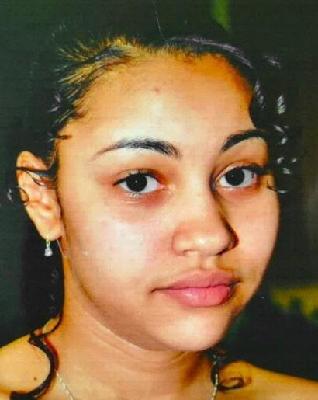
Carolyn Loretta Wasilewski was the oldest of seven children, a 14-year-old girl from the Morrell Park neighborhood of Baltimore, Maryland, known for her love of dancing. A freshman at Southern High School, she was also known by the nickname "Carolyn Wells." To her friends, she was a fun-loving teenager who enjoyed the jitterbug and ran with a crowd of youths known locally as “drapes,” a 1950s greaser subculture. Though some considered her to be living beyond her years, her family remembered the little girl who was buried in a flowing blue negligee after her life was brutally cut short.
On the evening of November 8, 1954, Carolyn told her family she was leaving her home on Mardel Avenue to meet a friend, Peggy Lamana, and register for a new dance program at a nearby elementary school. Dressed in a pink sweater, a black and pink patterned skirt, and a black corduroy jacket, with her hair in curlers under a green scarf, she stepped out around 6:15 p.m. and was never seen alive by her family again. She never met up with her friend. After a frantic night of searching, her parents' worst fears were realized the next morning.
Around 7:00 a.m. on November 9, a railroad engineer on a Pennsylvania Railroad train spotted a body on the tracks beneath the Belvedere Avenue bridge. It was Carolyn. Investigators determined she had been placed there in an attempt to have a train run over her body, an act that was narrowly avoided. The medical examiner found she had died around 11:00 p.m. the previous night from a fractured skull, and had also suffered a broken jaw and ribs. Her shoes and skirt were missing, and mysteriously, the name "Paul" was written on her right thigh in what appeared to be lipstick or Mercurochrome. Police quickly concluded she had been killed elsewhere and moved to the tracks.
The investigation led Baltimore police eight miles away to a vacant lot near her home, in the Mount Winans rail yard off Gable Avenue. There, they discovered bloodstains and some of Carolyn's personal belongings, identifying it as the primary crime scene where she had been beaten to death. The case set off an intensive manhunt, with police questioning more than 300 people, including many of Carolyn’s "drape" friends. The media coverage at the time fueled a moral panic about the youth subculture, creating a press circus and drawing gawkers to her funeral.
Investigators explored several angles. A week before her murder, on November 1, Carolyn had testified in a carnal knowledge case against a 45-year-old local mechanic who had allegedly assaulted one of her friends. Her father told police that someone had warned her about testifying. The man was questioned but was ultimately dismissed from the inquiry. A week after the murder, another man who had reportedly been seen talking to Carolyn was found hanging from a rail car near the vacant lot where she was attacked. However, police concluded his death was an unrelated suicide. Despite the massive investigation, no one was ever charged with her murder.
The slaying of Carolyn Wasilewski became a Baltimore legend, a story passed down through generations, its notoriety fueled by the fact that it remained unsolved. The case and the era's youth culture loosely inspired filmmaker John Waters' 1990 movie, "Cry-Baby." Her girlfriends served as pallbearers at her funeral, carrying her casket into St. Peter the Apostle Roman Catholic Church for a Requiem Mass. She was laid to rest in Holy Redeemer Cemetery.
Decades later, the case file for Carolyn Loretta Wasilewski remains open in the Baltimore Police Department's homicide unit. A retired homicide detective noted in 2000 that the department still received calls about the murder, usually around its anniversary. As of September 2025, the killing is recognized as one of the oldest and most haunting unsolved murders in Maryland's history, a chilling mystery that has endured for over 70 years.