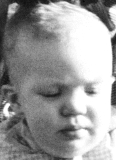
On a warm late summer day, September 6, 1958, in the small town of Goliad, Texas, one-year-old A.J. Campbell Jr. and his three-year-old sister, Myrisha Faye, were picked up by their father for a scheduled visit. Their mother, Jewel Bernay Campbell, had separated from their father, A.J. Campbell Sr., due to his abusive behavior and was raising the children on her own, working as a teacher. The father had court-ordered visitation on Saturdays and was expected to return the children by 3:00 p.m. That morning, he arrived with an acquaintance, William Randle Jr., in Randle's 1955 pink and charcoal-gray Chevrolet Tudor. A.J. was dressed in a blue and white checked shirt with a dark blue collar and a yellow diaper. The young boy had distinctive features, including clubbed thumbs and birthmarks on his upper eyelid and below his lower lip.
The father drove with his children and Randle, making stops in the nearby towns of Cuero and Gonzales, where he strangely purchased two large cans of lard. Just a few miles outside of Goliad, Campbell Sr. asked Randle to get out of the car, saying he wanted to visit a friend. He then drove off with A.J. and Myrisha still inside the vehicle. When he returned approximately 30 to 40 minutes later, the children were gone. Campbell Sr. appeared nervous and agitated, asking Randle if he had any blood on him and claiming he had been in a fight with a relative with whom he had left the children. The two men then drove to San Antonio, where they went their separate ways. Campbell Sr. was supposed to return the car to Randle but never showed up, prompting Randle to report the vehicle as stolen.
The following day, the tragic conclusion to this disturbing sequence of events began to unfold. A.J. Campbell Sr. telephoned a minister in Fort Worth, implying that he had killed his children, stating they were "at rest with the world," and that he intended to take his own life. Soon after, on September 7, his body was discovered inside Randle's car on a rural road near Austin. He had died from a self-inflicted gunshot wound. A note left behind for his estranged wife, Jewel, stated that he had "buried both children" and that he loved them. Despite this confession, an extensive search for A.J. and Myrisha yielded no trace of them. Their bodies have never been found, and the case remains open. While their father's note suggested a grim end, the absence of their discovery has left a sliver of hope for their surviving family members, who believe there is a possibility the children were given or sold to someone instead of being killed. This enduring mystery represents one of the oldest missing children's cases in Texas, a heart-wrenching story of two young siblings who vanished without a trace.Last Seen: Sep 6, 1958