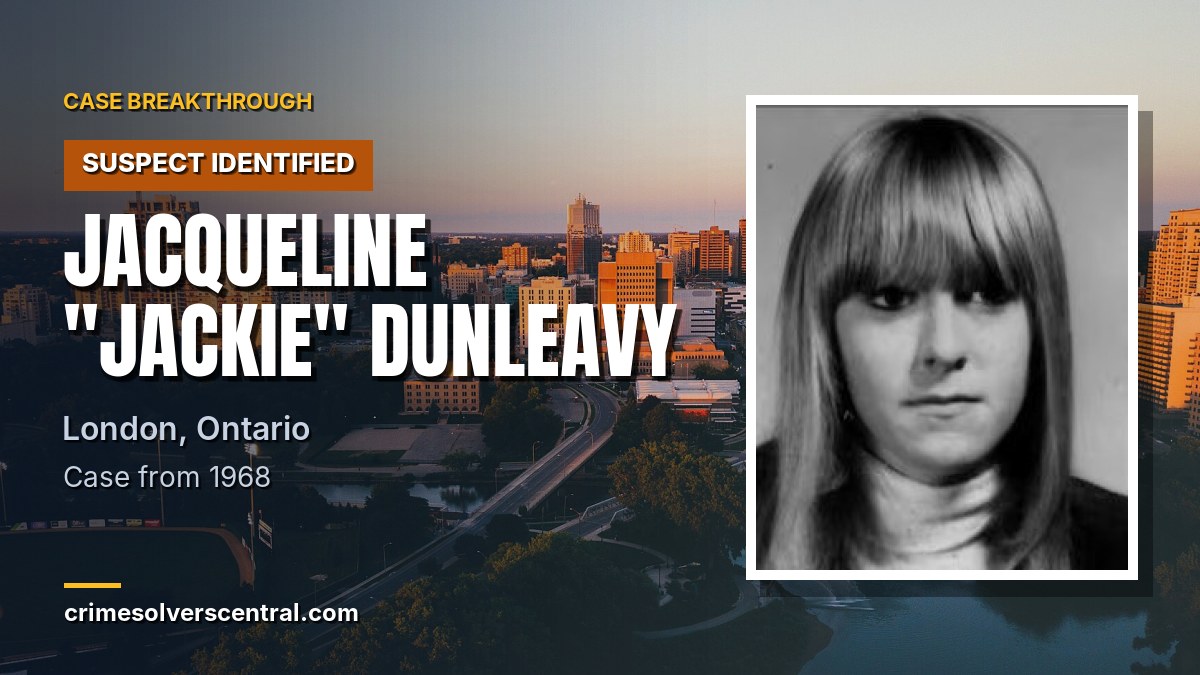
London Police say DNA and forensic genealogy identified Michael Joseph Moore as the man linked to the 1968 murder; Moore died in 2018, so no charges can be laid.
What happened
On Nov. 23, 2026 London Police announced that modern forensic DNA testing and investigative genetic genealogy identified Michael Joseph Moore as the person linked to the 1968 killing of 16-year-old Jacqueline “Jackie” Dunleavy. Investigators said preserved biological evidence from the original investigation was re-examined, DNA was sent to Othram Labs and genealogical analysis narrowed the focus, leading to additional interviews and comparison of new forensic samples that matched Moore.
Police said Michael Joseph Moore (born 1942) was 25 at the time of the killing. Moore later served as a firefighter in London and retired with the rank of captain. He died on March 3, 2018, and investigators said because he is deceased no criminal charges can be laid. London police said there is no evidence Dunleavy and Moore knew each other.
London Police held a news conference at headquarters to announce the breakthrough. Investigators emphasized the careful preservation of evidence from 1968 and credited advances in forensic science and persistence by past and present detectives for producing an identification.
Case background
Jackie Dunleavy was a Grade 10 student at Westminster Secondary School in London and worked at the Stanley Variety Store on Stanley Street. On Jan. 9, 1968 she finished her shift at about 6:30 p.m. and was last seen walking from the store, likely to catch a bus. Witnesses later reported seeing a girl matching her description waiting at a bus stop and getting into a white vehicle.
Her remains were found around 8 p.m. that evening on the grounds of Katherine Harley School (now Matthews Hall) on Oxford Street. The cause of death was ruled strangulation. Investigators at the time collected witness statements and biological material, which was preserved and later re-examined.
The case was revisited through several reviews over the decades, including Project Angel (a joint London Police and Ontario Provincial Police cold-case task force from 1997 to 2001). Moore’s name surfaced during that earlier review but he was not named as a suspect then, and records related to that inquiry are reported to have been lost. The case has also been chronicled in books about London’s cold cases and serial-homicide era.