

The Best Cold Case Database: How the Main Options Compare

There is no single best cold case database, because no one system holds every case. For most families and researchers, the strongest approach is to pair the public federal missing-persons system with a searchable national catalog that is organized by state and case type. That is what we built Crime Solvers Central to be: a database of 264,913 cases, sorted by state and situation, with member tools for working a case.
Below, we compare the options by type: federal databases, the FBI’s violent-crime repository, state-run sites and community-built case archives. For each one you will see who can use it, what it covers and where to start.
TL;DR
- NamUs is the public federal database for missing, unidentified and unclaimed persons. NCIC, the FBI’s larger system, is closed to the public.
- State cold case sites, such as Virginia’s, list only the cases that agencies choose to publish, so coverage reflects agency practice and not the true number of open cases.
- Crime Solvers Central offers a searchable national database of 264,913 cases, organized by state and case type, plus tools for flyers, evidence boards and volunteer work.
- Official records disagree and overlap. Search more than one system, and verify any case status with the investigating agency.
- Plans start at $3.97 per month, and tips should always go to the agency that owns the case.
Table of Contents
- What makes a cold case database the best one for you
- The main types of cold case databases at a glance
- NamUs: the public federal database
- NCIC: the system the public cannot search
- FBI ViCAP: violent crime cases, selected for the public
- State cold case databases
- Crime Solvers Central: a national catalog with tools to act
- Why one database is never enough
- A practical search routine
- Submitting a tip the right way
- Checking whether a case is still open
- Our perspective
- Start with the full case files
- FAQ
- Sources
What makes a cold case database the best one for you
The right database depends on what you are trying to do. A family looking for a missing relative needs something different from a student writing a thesis or a volunteer who wants to help organize a flyer campaign. Five criteria separate the options.
- Who can see it. Some systems are public. Others are limited to authorized law enforcement.
- What it covers. Missing persons, unidentified remains, unsolved homicides, or all three.
- How you can search it. State, case type, name, age, physical characteristics or circumstances.
- How current it is. Who adds cases, who removes them and how often records are checked.
- What you can do next. Submit a tip, build a flyer, join a community or only read.
Keep these in mind as you read the comparison. One honest point applies to every option: a public database measures what agencies and organizations have published, not every case that is actually unresolved.
The main types of cold case databases at a glance
| Option | Public access | Case types | Best for |
|---|---|---|---|
| NamUs (federal) | Yes, public users can access published information | Missing persons, unidentified persons, unclaimed remains | Families and researchers matching missing and unidentified records |
| NCIC (FBI) | No, authorized agencies only | Missing and unidentified persons within a 21-file system | Law enforcement |
| ViCAP (FBI) | Selected cases displayed publicly | Homicides, sexual assaults, missing persons, unidentified remains | Following featured violent-crime cases |
| State cold case sites (for example Virginia) | Yes | Unsolved homicides, missing persons, unidentified remains, often with age cutoffs | Residents of that state |
| Crime Solvers Central | Searchable catalog, with full case details for members | Missing persons, unsolved homicides, unidentified and unclaimed remains | Families, volunteers and researchers who want a national view by state plus working tools |
The sections below go through each one.
NamUs: the public federal database
NamUs is the system most families meet first. According to a fact sheet from the Office of Justice Programs, NamUs 2.0 stores missing-person, unidentified-person and unclaimed-remains records, and public users can access published information.
How NamUs searching works
The Department of Justice’s privacy impact assessment says NamUs supports public searching and user-defined advanced searches. You can filter by location, demographics, circumstances, and physical and medical characteristics. Its matching tools compare missing, unidentified and unclaimed-person records against each other.
That last feature is what makes it valuable. A family member entering a distinctive tattoo or dental detail may find a link to an unidentified-remains record in a different state.
How cases get in
Registered users can enter missing-person cases, but under the NamUs User Guide a regional system administrator verifies the report with the appropriate law-enforcement agency and obtains permission before publication. The guide also says NamUs is meant to complement the FBI’s NCIC for long-term cases. Its resources generally benefit cases that have been active more than 180 days, while imminent risk may justify earlier entry.
If you want a walkthrough, our step-by-step NamUs search guide for families covers the screens and filters.
NCIC: the system the public cannot search
NCIC is the FBI’s national criminal-justice information system. The same fact sheet explains that it holds 21 files, including missing-person and unidentified-person files, and that it is not available to the public. Authorized law-enforcement and criminal-justice agencies reach it through CJIS channels.
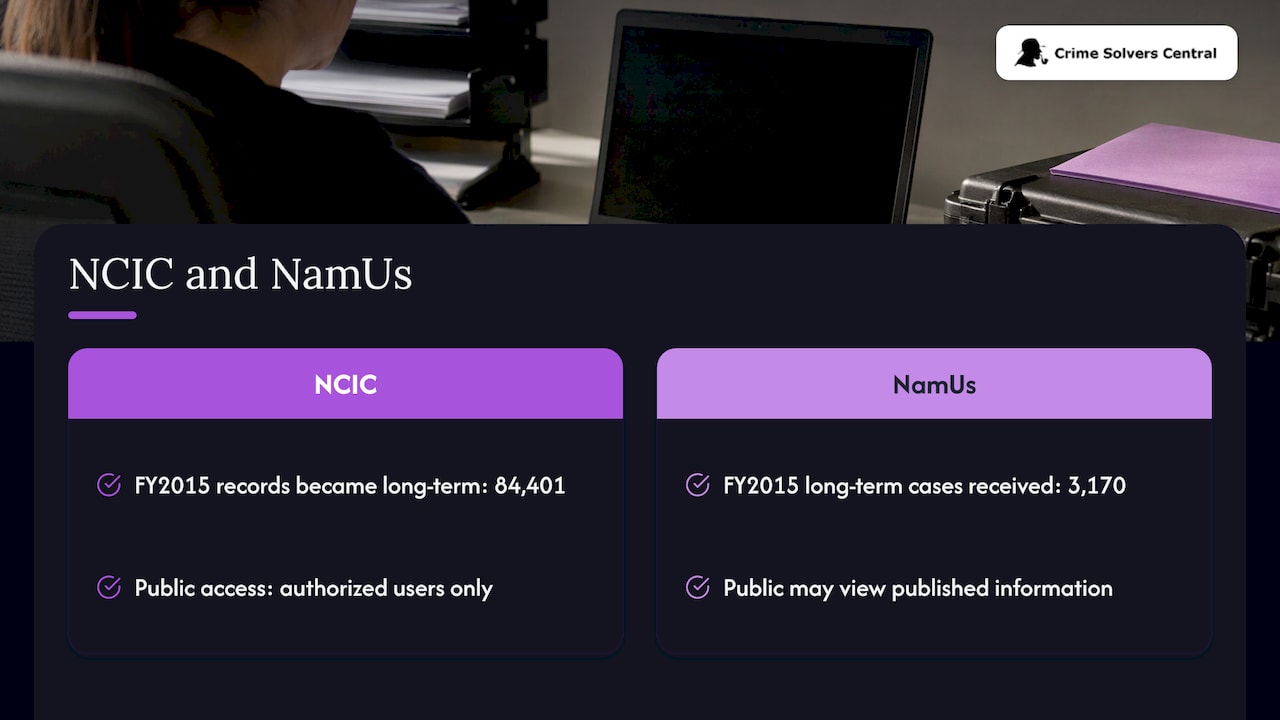
Why does this matter to you? Because a missing-person report you file with police is typically entered into a system you cannot see. A GAO report found that NCIC access is restricted to authorized users, that the public may register to view published NamUs information, and that the two systems have no direct links. The practical lesson: ask the detective whether your case is in NCIC, and check separately whether it is in NamUs.
The scale of the problem shows in the numbers. GAO reported that in fiscal year 2015, NamUs received 3,170 long-term missing-person cases, while 84,401 NCIC missing-person records became long-term cases. The two systems capture very different slices of the same problem.
FBI ViCAP: violent crime cases, selected for the public
The FBI describes ViCAP as the largest investigative repository of major violent crime cases in the country. It includes homicides, sexual assaults, missing persons and other violent crimes involving unidentified human remains. Investigators use it to spot patterns across jurisdictions.
The public page, though, displays only selected cases. It is a place to read featured cases and tips, not a full searchable catalog. If you are a student or community researcher, treat it as a window into the kinds of cases investigators are connecting, not as a way to find every case in your county.
State cold case databases
Several states run their own sites. Virginia is a clear example. The Virginia State Police Cold Case Database displays unsolved homicide, missing-person and unidentified-remains cases that are at least five years old. Each case page has a Submit a Tip form or directs you to the reporting agency.
Two things are worth knowing about state sites:
- They depend on submissions. Virginia’s policy is voluntary submission by agencies. A case missing from the site is not necessarily solved, and the site itself says to contact the investigating agency if you cannot find a case.
- They stop at the state line. A person who disappeared in one state may be found in another, so a single state site can miss the connection.
State databases are excellent for local detail. They are not designed to give a national view, which is where a catalog organized by state and case type helps.
Crime Solvers Central: a national catalog with tools to act
Crime Solvers Central is a searchable national database of 264,913 cold cases: missing persons, unsolved homicides and unidentified or unclaimed remains. Cases are categorized by state and by situation, so you can start from a map of your own state or browse by case type. You can begin on our cold case database by state.
Anyone can search the catalog. Members unlock the full case details, sources, videos and forums. Our member tools are built for people who want to do something with a case, not only read it:
- Digital evidence boards for organizing what is known about a case
- A flyer builder for printing missing-person flyers
- A.I. image progression tools
- Volunteer coordination, safety initiatives and community forums
Our site also carries testimonials from people who used the resources, including reconnections of families and help to law-enforcement investigations. For researchers who want to work systematically, our cold case search engine playbook shows how we approach it. Our guide to using NamUs and Crime Solvers Central together explains why we suggest running both searches for the same person.
What it costs
Membership is a recurring subscription. The published plans, from our pricing page, are:
| Plan | Monthly | Yearly |
|---|---|---|
| Jr. Detective | $3.97 | $39 |
| Sr. Detective | $9.97 | $99 |
| True Crime Influencer | $39.97 | $399 |
Choose the plan that fits how deeply you plan to work: Jr. Detective to start browsing full case files, Sr. Detective for regular research, and True Crime Influencer if you create content around cases. Annual billing lowers the per-month cost on every plan.
Why one database is never enough
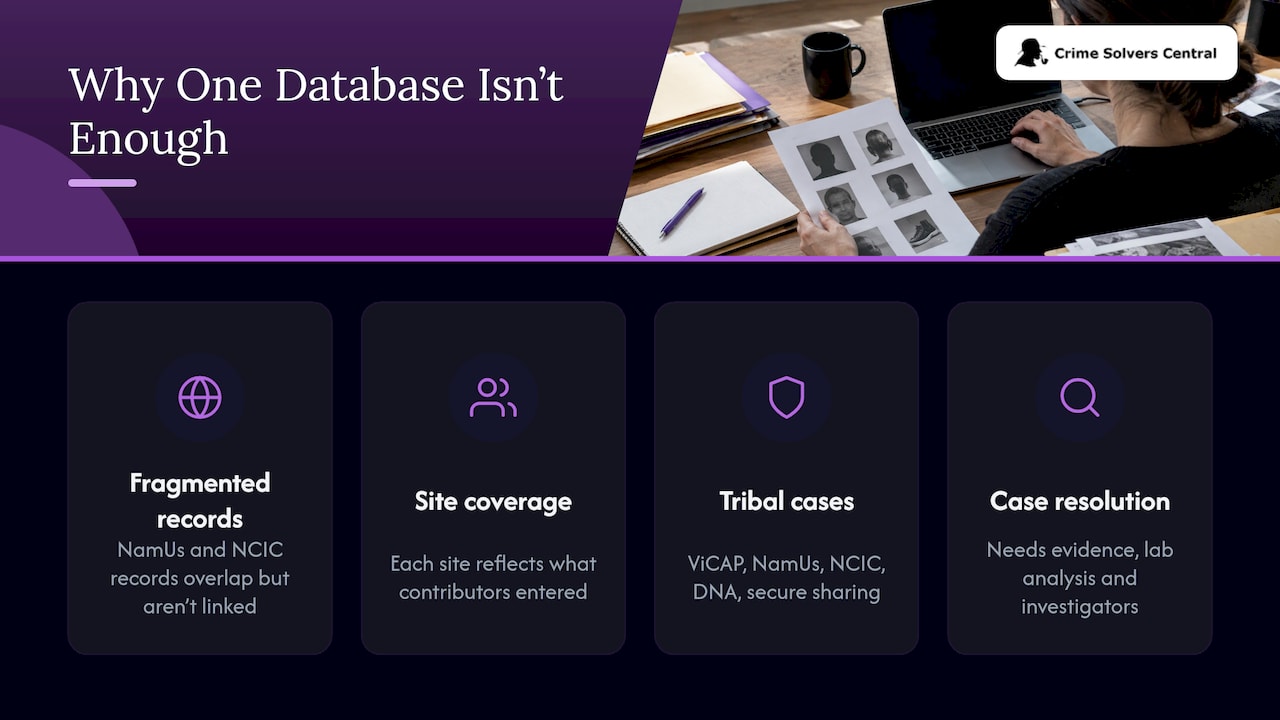
GAO’s comparison indicates that relying on one system can miss information, because NamUs and NCIC hold overlapping but fragmented records that are not directly linked. The same logic applies to every public site. Each one reflects what its own contributors chose to enter.
For cases involving Indigenous people, the Department of Justice’s tribal law enforcement resource list names ViCAP, NamUs, NCIC, forensic DNA resources and secure information-sharing tools. The point is that unresolved cases often need tribal, local, state and federal resources working together, not a single public website.
Databases also sit at the start of the work, not the end. A record can identify a person or link two cases, but resolving a case usually depends on evidence, laboratory analysis and investigators. If you want background on that side, this overview of forensic testing in criminal justice shows how lab results fit into investigations.
A practical search routine
Here is the sequence we recommend to families and volunteers.
- Start with NamUs. Search by location, demographics and physical characteristics. Use the matching features for missing and unidentified records.
- Check the state site. If your state has an official cold case database, search it. Note which agency owns each case.
- Search a national catalog. Run the same details through Crime Solvers Central to see cases organized by state and situation, then compare what you find with the official records. Our guide to advanced NamUs searches and FOIA triage goes deeper on search technique.
- Write down your sources. Record where each detail came from, and separate what you observed from what you infer.
- Contact the agency. Take anything substantive to the investigators on the case.
For older newspaper coverage, which often fills gaps in the official record, see our list of archive options for cold case research. To judge how reliable each source type is, read our guide to vetting cold case information sources.
Submitting a tip the right way
Tips belong with the agency that owns the case. Most official case pages make this simple. On a Virginia case page, use the Submit a Tip form or contact the reporting agency listed. If a case is not in the database, contact the investigating agency directly.
For missing or murdered cases in Indian Country, the Bureau of Indian Affairs accepts tips by text to 847411 (begin the message with BIAMMU), by phone at 1-833-560-2065, or by email to [email protected]. BIA asks you to be specific and to submit information once. Tipsters receive a reference number for confidentiality, and the standard reward may be up to $5,000, subject to the eligibility and case-outcome conditions BIA states.
What volunteers can responsibly do
The Department of Justice’s review of unresolved cases emphasizes coordinated use of databases, forensic information and agency resources. For community researchers, that translates into a few habits:
- Keep track of where every fact came from.
- Separate what someone saw from what you suspect.
- Never publicly accuse a person who has not been charged.
- Protect personal information about families and witnesses.
- Send substantive leads to investigators. Do not confront anyone or touch potential evidence.
These habits are built into how we run our volunteer coordination and evidence boards: organize, document, then hand it to the agency.
Checking whether a case is still open
Cases do get solved after appearing in public databases. The DOJ review documents later identifications and renewed investigations, and notes that NamUs supports archiving resolved cases by removing them from public view. So a case vanishing from a listing does not prove it was solved. It can reflect archival or administrative action.
The reliable way to check status is to ask the investigating agency or consult the current official case page. If you find a case on any site, including ours, confirm its status with the agency before you share it widely or act on it.
Our perspective
We have spent years watching the same pattern: families search one site, find nothing and assume nothing exists. In reality the records are scattered across federal systems, state sites, newspapers and community archives, and no one of them is complete.
That is why we built a national catalog organized by state and situation. Over 264,000 cases in one place means a family can see their state, their case type and neighboring cases without learning a different search screen for each source. Our digital evidence boards, flyer builder, volunteer coordination and A.I. image progression tools exist because finding a case is only the first step. People want to do something with what they find.
We also believe in community. The cases that move are usually the ones people keep talking about, and our testimonials show families reconnected and investigators helped. Our advice is simple: search NamUs, search your state, search us, and take every real lead to the investigators.
Crime
Start with the full case files
If you are ready to go beyond summaries, a membership opens the full case details, sources, videos, forums and tools. See the plans on our pricing page, starting at $3.97 per month for Jr. Detective. If you need to print a flyer right away, our flyer builder is the quickest place to begin.
FAQ
What is the best free way to search for a missing person?
Start with NamUs, where public users can search published missing, unidentified and unclaimed-person records. Then check your state’s official cold case site if it has one. Our own catalog also lets you search by state and case type before you decide on a membership.
Can the public search NCIC?
No. NCIC is restricted to authorized law-enforcement and criminal-justice agencies. Ask the detective on your case whether the person is entered in NCIC, and check NamUs yourself to see whether a public record exists.
If a case disappears from a database, was it solved?
Not necessarily. A record may be archived or removed for administrative reasons, and NamUs can remove resolved cases from public view. Contact the investigating agency to learn the actual status.
Where do I send a tip about a cold case?
Send it to the agency that owns the case. Official case pages, such as Virginia’s, include a Submit a Tip form or name the reporting agency. For missing or murdered cases in Indian Country, BIA takes tips by text, phone or email.
How is Crime Solvers Central different from government databases?
Government systems are run by agencies and reflect what they publish. Our catalog gathers 264,913 cases organized by state and situation, and adds member tools such as evidence boards, a flyer builder and volunteer coordination. We recommend using both.
Sources
- Operation Lady Justice: Comparison of the NamUs and NCIC Databases (Office of Justice Programs)
- NamUs Privacy Impact Assessment (DOJ)
- NamUs User Guide (NIJ)
- Missing Persons and Unidentified Remains (GAO-16-515)
- FBI ViCAP Homicides and Sexual Assaults
- Virginia State Police Cold Case Database
- Tribal Justice and Safety: Resource Basket for Law Enforcement (DOJ)
- Submit a Tip or Case Information (Bureau of Indian Affairs)
- Unresolved Cases: A Review of Protocols and Resources (DOJ COPS)
- Benefits of Forensic Testing in U.S. Criminal Justice