

Unsolved Shootings: Why They Stall and How to Help
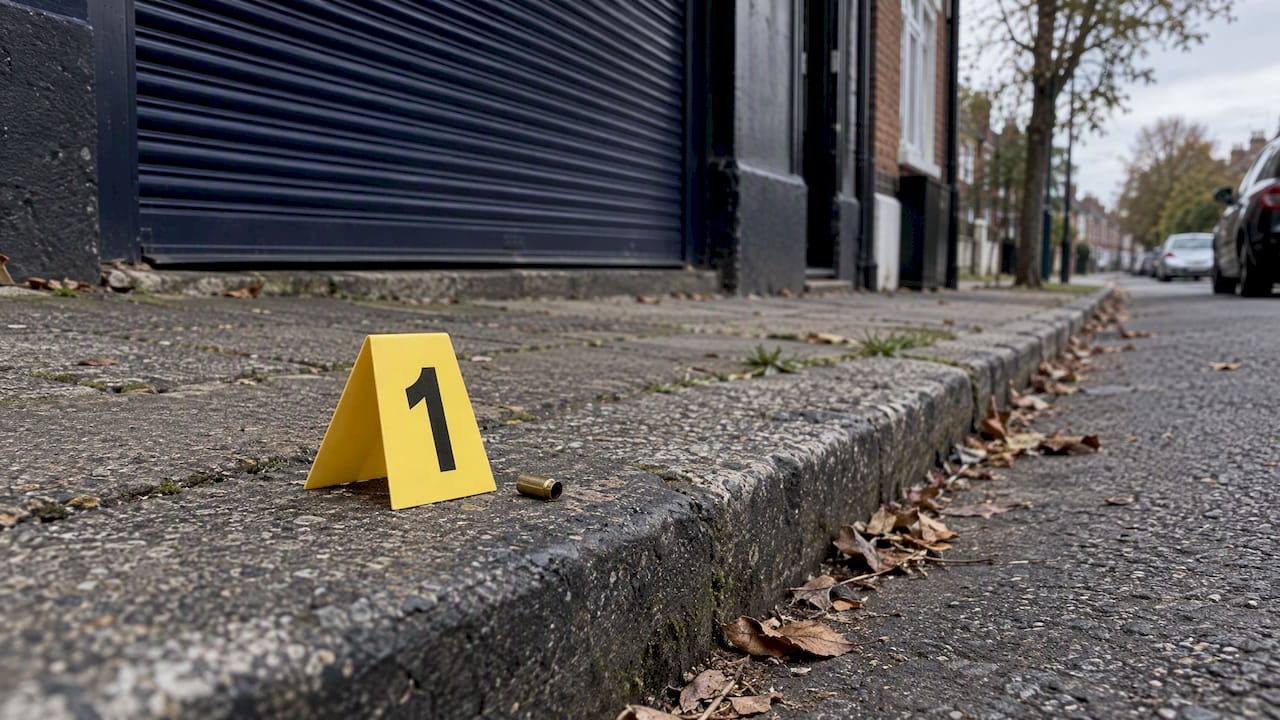
An unsolved shooting is a firearm attack, fatal or not, where no one has been arrested and charged. In the United States, that describes roughly half of fatal shootings and about two in three nonfatal ones. Most stall because physical evidence is thin, witnesses stay silent, and detectives carry too many cases. Most can still move forward when someone with real information comes forward through the right channel. This guide explains the numbers, the reasons, what a cold case means, and how families and volunteers can help safely.
TL;DR
- In 2024, 47.9% of fatal and 66% of nonfatal shootings in FBI NIBRS data were uncleared.
- Shooters often fire from a distance and leave little behind, and nonfatal cases get far less detective time.
- There is no national rule for when a case turns cold. Many agencies use one to three years.
- Tips, new forensic testing and renewed witness contact are what usually reopen cases.
- Send information to the investigating agency or a tip line first. Never confront suspects or run your own investigation.
Table of Contents
- How many shootings go unsolved in the US?
- What makes a shooting “cold”?
- Why shootings stay unsolved
- How investigators reopen an unsolved shooting
- What information helps most
- How to submit a tip safely
- How families and volunteers can help without getting in the way
- Our perspective
- Follow unsolved cases with a membership
- FAQ
- Sources
How many shootings go unsolved in the US?
The most recent full-year figures come from a 2026 analysis of 2024 FBI National Incident-Based Reporting System (NIBRS) data. It counts 13,010 fatal and 40,937 nonfatal shootings, with 47.9% and 66% uncleared. The same analysis estimates that about 75,000 people were shot by a criminal assailant in 2024, with about 15,000 of those shootings fatal.
Two cautions help you read those figures:
- “Uncleared” is not the same as “never solved.” A case counts as cleared when police arrest someone or close it by exceptional means. An uncleared case may still be solved years later.
- Reporting is incomplete. NIBRS depends on participating agencies, so totals are estimates built from what agencies submit.
The gap between fatal and nonfatal shootings is the part that surprises most people. A death brings a homicide squad, a medical examiner and a prosecutor’s attention. A nonfatal shooting, where the victim survived, often lands on a patrol detective with a stack of other files. Many of those survivors never see an arrest, and their cases rarely appear on any public “unsolved” list.
What makes a shooting “cold”?
A shooting is unsolved from the moment it happens. It becomes cold when active work stops. The National Institute of Justice notes that there is no universally accepted metric for when a case becomes cold, and many jurisdictions simply use one year as the line.
Some agencies set a longer clock. The Houston Police Department, for example, treats a case as cold when all probative leads are exhausted and the case stays open and unsolved after three years.
In practice, “cold” means three things together:
- No detective is actively working the file day to day.
- The known leads have been followed and went nowhere.
- The case stays open, and new information could still revive it.
That last point matters for families. A cold case is not a closed case. If you are looking for where unsolved cases are listed and how to follow them, our guide to where to search and how to help with unsolved crimes is a good starting point.
Why shootings stay unsolved
No single cause explains it. The research points to a handful of repeating problems.
Thin physical evidence
The NIJ’s review of cold case practice says cases go cold because of lack of evidence, strained resources or ineffective investigation. Firearm cases add their own problem. Shooters often fire from a distance, and that leaves little evidence behind. A drive-by may leave casings and a bullet, but no fingerprints, no DNA and no close-up witness.
Caseloads
Reporting by The Trace found that detectives working nonfatal shootings often carry caseloads far higher than homicide squads. Combined with the evidence problem, that helps explain why nonfatal clearance rates run so much lower. Sensor technology is one response some departments consider. A buyer’s overview of gunshot detection questions shows how detection systems are meant to pinpoint where shots were fired. Pinpointing a location still does not identify a shooter, so detection helps most when it is paired with witnesses and follow-up.
Witnesses who will not talk
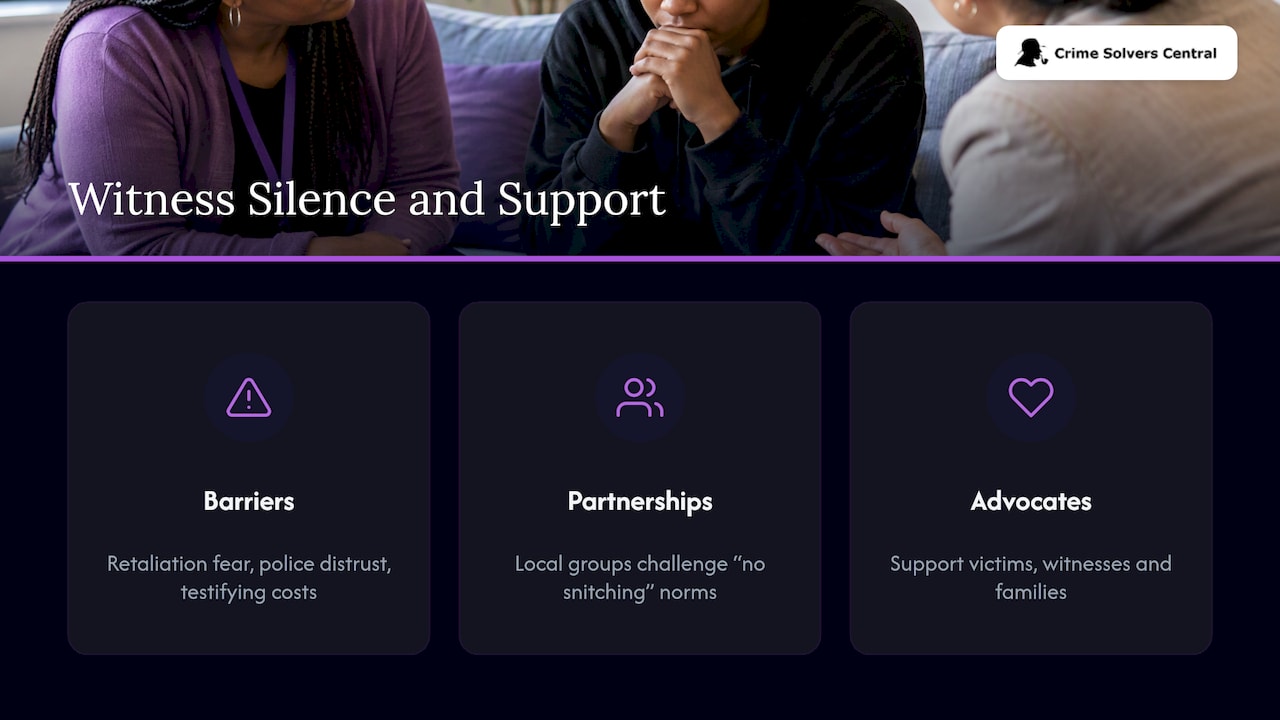
Many shootings happen in front of people who say nothing. Fear of retaliation, distrust of police, and the cost of testifying all play a part. The National Case Closed Project recommends that agencies partner with local organizations to challenge “no snitching” norms and build police-community trust. It also encourages agencies to give victims, witnesses and families an advocate so trust continues whether or not the witness decides to take part in the legal process. How inquiries treat witnesses and evidence is a topic in its own right, and a look at evidence and witnesses in inquiries shows how much a case depends on what witnesses are able to say and how well they are supported.
The first 72 hours
The NIJ also reports that solvability drops sharply after the first 72 hours, which is why it suggests that cold case techniques could be useful much earlier in an investigation. If a shooting happened this week in your area, your information is at its most valuable now.
How investigators reopen an unsolved shooting
When a department takes a fresh look, it usually follows a recognizable path. The National Case Closed Project’s recommendations call for formal case reviews, use of technology and data, manageable caseloads, and coordination with prosecutors.
In day-to-day terms, that looks like this:
- Review the whole file. A new detective reads every report, statement and lab result, looking for leads that were missed or never followed up.
- Re-test the evidence. Casings, bullets, clothing and other items may be eligible for tests that did not exist, or were too costly, when the shooting happened. Cold cases have been resolved after new forensic testing or new witness information prompted investigators to look again.
- Re-interview witnesses. Relationships change over time. Someone who was afraid, loyal or underage then may talk now. The NIJ’s guide to eyewitness evidence stresses building rapport and asking open-ended questions to get the most accurate account.
- Organize the file. The National Case Closed Project recommends a “Murder Book” structure so reporting is consistent and supervisors can approve it.
- Take it to the prosecutor. A reopened case needs enough admissible evidence for a charge, not just a strong suspicion.
Many departments set up dedicated cold case squads for this work. Those squads exist to work the backlog without being pulled onto new crimes. If your agency has none, the case may sit with the original detective or a shared unit, so ask who currently owns it.
What information helps most
Detectives rarely need a full theory. They need a specific, checkable detail. Useful information tends to fall into a few types:
| Type of information | Example | Why it matters |
|---|---|---|
| Who | A name, nickname, or vehicle owner someone mentioned | Gives detectives a person to check against evidence |
| What you saw or heard | A conversation after the shooting, a car leaving fast | Corroborates or contradicts earlier statements |
| Digital material | Doorbell or phone video, photos, social posts from that night | Can show a time, direction, plate or face |
| Relationships | A dispute, debt or feud that preceded the shooting | Helps establish motive |
| Changes since | A person who has now left a group or moved away | May indicate someone ready to talk |
Write down dates, places and how you know each detail. Say clearly what you saw yourself and what you only heard from others. Do not alter or delete anything, including old messages and video files.
How to submit a tip safely
Start with the agency that owns the case. Most police and sheriff’s departments list a cold case or homicide tip line on their website, and many unsolved case pages, like the Columbia Police Department’s, publish a direct line for tips. Then pick the channel that fits your comfort level:
- Call the detective or unit. Best when you want to be contacted and can give a name.
- Use a Crime Stoppers tip line. These local programs take anonymous tips by phone, text or web form. Boston’s, for example, takes calls, texts and web or app tips without asking for your name, then gives you a tip ID so you can check on the tip anonymously. Search for your own city or county’s program, since each one runs separately.
- Tell the FBI for federal crimes. The FBI accepts tips at tips.fbi.gov, and tips can be anonymous. It is the right place for cases with a federal angle, such as a shooting tied to interstate crime. Most local shootings are handled by local agencies.
Whatever the channel, never go to the scene to “gather proof,” and do not confront the person you suspect. Do not post a suspect’s name online. You could put a witness in danger, taint testimony or expose yourself to a defamation claim. For a longer walk-through, see our guides on how to report information about a cold case and how to crowdsource tips on unsolved homicide cases.
How families and volunteers can help without getting in the way
Families often feel they must do something. The most effective help is steady and cooperative.
If your loved one was shot:
- Ask the agency for the case number, the name of the current detective and the date of the last review. Keep a log of every call.
- Ask for a victim advocate. Agencies are encouraged to provide advocates for victims, witnesses and families, and an advocate can help you with updates and with the court process.
- Keep their story visible. Anniversaries, a photo and a short fact sheet can prompt someone to call. Check the details with the detective before you publish, so you do not name a suspect or reveal facts only investigators know.
If you are a volunteer:
- Work through the family and the agency, not around them.
- Spread verified information: the case number, the tip line and the reward, if any. Do not speculate.
- Help build neighborhood trust, for example by supporting local groups that work with police on violence prevention.
Our guides on a safe plan for families and volunteers and on collaborating with communities on unsolved crimes go step by step. If you want to widen attention to victims who get little coverage, our guide to amplifying overlooked cold case victims covers that.
Our perspective
We built Crime Solvers Central around a simple observation: cases do not stay unsolved only because nobody cares. They stay unsolved because information is scattered. A family in one state holds a detail, a witness in another holds a different one, and the case page that could connect them is buried or missing.
Our database holds more than 264,000 cold cases, sorted by state and situation, covering missing persons, unsolved homicides and unidentified remains. We think this structure matters for shootings in particular. Fatal shootings often appear in our homicide listings, and the same state-by-state view lets a reader compare cases from one area, spot patterns, and find the right agency to contact.
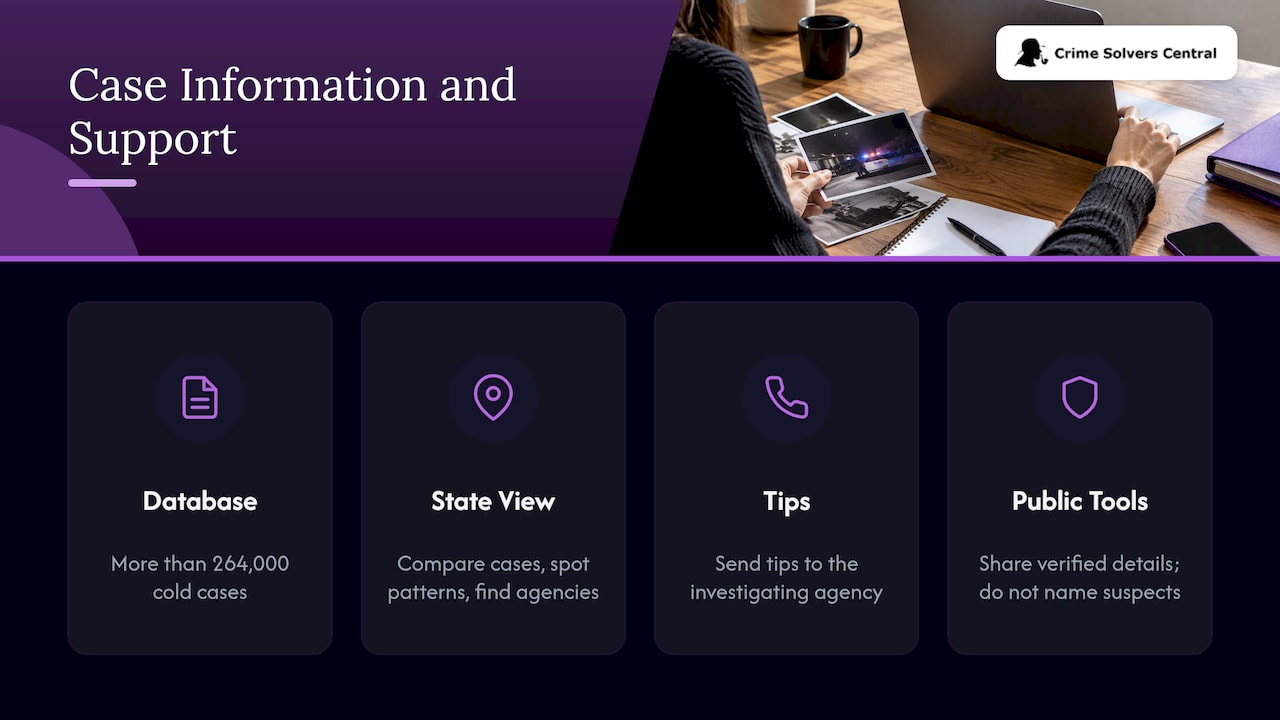
We also hold a firm line about what the public should do. A tip belongs with the investigating agency. Our digital evidence boards, flyer builder and forums are for organizing public information, sharing verified case details and supporting families, not for naming suspects or replacing detectives. Members tell us the most useful thing the community gives them is not a theory but a place to share a case number with the right audience.
Unsolved shootings, especially the nonfatal ones, receive the least attention of any violent crime. We want more of those cases visible, so that one person who knows something has a reason to speak up.
— Crime
Follow unsolved cases with a membership
If you want to follow cases in your state, our free pages give you summaries and guides. A paid membership unlocks full case details, sources, videos, forums, digital evidence boards and the flyer builder. Current plans:
| Plan | Monthly | Yearly |
|---|---|---|
| Jr. Detective | $3.97 | $39 |
| Sr. Detective | $9.97 | $99 |
| True Crime Influencer | $39.97 | $399 |
See what each plan includes on our pricing page, or start from the cold case database by state. You can also read more on recent unsolved murders and the clues behind unsolved homicides before you decide.
FAQ
How many shootings are unsolved in the US?
In 2024 FBI NIBRS data, about 47.9% of 13,010 fatal shootings and 66% of 40,937 nonfatal shootings were uncleared. That is a large share of cases. Local rates vary widely by city and agency, so check your own police department’s published clearance data.
Is an unsolved shooting the same as a cold case?
No. A shooting is unsolved until someone is charged, but it is cold only when active investigation stops. Agencies draw that line differently, usually between one and three years after the crime. A cold case stays open and can be revived by new evidence or a tip.
Can a nonfatal shooting be investigated as a cold case?
Yes, though many agencies focus cold case units on homicides. A nonfatal shooting can still be reviewed, especially if the victim, a witness or new evidence prompts it. Ask the detective’s unit directly whether the file is open and who owns it.
Can I send a tip anonymously?
Yes. Many local Crime Stoppers programs accept anonymous calls, texts and web tips, and the FBI accepts anonymous tips for federal matters. Anonymous tips are easier to act on when they include specific dates, places and details that can be checked.
Sources
- Why and How to Boost Clearance Rates for Unsolved Shootings (2026)
- Cold Case Investigations: An Analysis of Current Practices (National Institute of Justice)
- What is a Cold Case (Houston Police Department)
- 5 Things to Know About Cities’ Failure to Arrest Shooters (The Trace)
- The National Case Closed Project’s Top 10 Recommendations
- Eyewitness Evidence: A Guide for Law Enforcement (National Institute of Justice)
- Cold Cases (EBSCO Research Starters)
- Crime Stoppers Anonymous Tips (Boston Police Department)
- Electronic Tip Form (FBI)
- Gunshot detection buyer’s guide
- Evidence in inquiries: what witnesses must know