

True Crime Blog: How to Read One and Start Your Own

A good true crime blog does three things: it gets the facts right, it treats victims as people, and it gives readers something to do besides scroll. Most of what ranks for this topic is a feed of clippings, a personal hobby page or a podcast companion. The best of them still share one trait: the writer can tell you where every claim came from. This guide shows you how to judge a blog, how to build one, and how to anchor your posts in real case records.
TL;DR
- A trustworthy true crime blog names its sources, separates confirmed facts from speculation and links to official records.
- Victim dignity is a writing standard, not a courtesy. Federal victim-services guidance on media is a practical place to set yours.
- The strongest niche for a new blog is a narrow one: a single state, a case type or a method, not “all true crime.”
- Cold case databases give you verifiable case profiles, and they give readers a way to act on what they read.
- Never publish tips, theories or names that could interfere with an active investigation or hurt a family.
Table of Contents
- What a true crime blog is, and what ranks today
- How to tell a trustworthy true crime blog from a noisy one
- Choose a niche that gives readers a reason to return
- Write about victims the way their families would want
- Be careful with forensic claims and courtroom stories
- What to put in a case post
- Where a cold case database fits into your blog
- Handle missing child content with extra care
- Our perspective: a blog should move a case forward
- Build your blog in seven steps
- For readers who want to do more than read
- FAQ
- Sources
What a true crime blog is, and what ranks today
A true crime blog is a regularly updated site that covers real crimes: homicides, disappearances, trials, investigations and the aftermath. The format is flexible. Some are long-form narrative, some are court reporters posting trial notes, some are hobbyist archives, and some are social accounts that clip news about current US cases.
Looking at what appears for this search, you see that range. There are journalism-driven sites that follow a single case closely, personal pages built around one writer’s interests, long-running archive sites that collect author pages and articles on famous offenders, and social feeds posting daily stories. What they share is volume and a loyal niche. What most lack is a clear standard for sourcing and a reason for a first-time visitor to trust the page.
That gap is your opening, whether you read these blogs or want to write one.
How to tell a trustworthy true crime blog from a noisy one
True crime attracts a huge audience, and that audience is easy to mislead. Before you follow a blog, run it through these checks.
- Does it cite primary records? Court filings, police press releases, medical examiner statements and official databases beat “sources say.”
- Does it label speculation? A good writer says “investigators have not confirmed” and means it.
- Does it update and correct? Cases move. A post from three years ago that never mentions an arrest or exoneration is a warning sign.
- How does it treat the victim? Look for the person’s name, life and family, not only the worst day.
- Does it protect the living? Families, witnesses and minors should not be doxxed or turned into characters.
- Does it tell you where to send a tip? A blog that sends readers to the proper law enforcement line is working with justice, not around it.
If a blog fails two or more of these, treat it as entertainment, not information.
Choose a niche that gives readers a reason to return
General true crime is crowded and shallow. Specific coverage builds authority. A few angles that work:
- A state or region. Local readers care about local cases, and local knowledge (county names, newspapers, courthouse habits) is hard for big sites to fake.
- A case type. Unsolved homicides, long-term missing persons or unidentified remains each have their own vocabulary and records.
- A process. Explain how a missing persons report works, what happens at trial, or how evidence is handled. Readers search for these answers when a case hits close to home.
- A verification beat. Check viral claims about recent cases and publish what holds up.
That last one is underused. Missing persons posts spread fast on social media, and many circulate after the person is found or with details that are wrong. A blog that earns a reputation for checking first is valuable. Our own guide to recent missing persons cases and how to verify before you share lays out that habit.
Write about victims the way their families would want
The ethical core of a true crime blog is how it handles the people at the center. The Office for Victims of Crime (OVC) publishes Privacy & Dignity: A Guide to Interacting With the Media, a 26-page guide written for victims and advocates dealing with the press. Reading it from the writer’s side is useful: it shows what families experience when coverage goes wrong.
The OVC also publishes a guide for journalists who report on crime and crime victims, a 66-page document from 2009 by Bonnie Bucqueroux and Anne Seymour. Even if you are a hobbyist and not a credentialed reporter, it is a solid reference for interviewing and describing victims.
A working code for your blog might include:
- Use the victim’s name and a photo the family has shared or that police released, not the most graphic image available.
- Describe the person before the crime. Hobbies, work and relationships belong in the story.
- Avoid blaming language. Do not hint a victim “should have” done something differently.
- Leave out details that only serve shock: methods of killing beyond what is necessary, graphic scene descriptions.
- Ask before contacting families, and accept a no.
- If a family designates a spokesperson, direct questions there. Advocacy guidance recommends that families choose a single trusted spokesperson to keep messages consistent and limit re-traumatization from speculative reporting.
It also helps to understand what victims go through in the system you are describing. When you write about court processes, explain who supports victims there. For example, an explainer on what victim witness advocates in Massachusetts do shows readers there is help beyond the headline, and it is the sort of context that makes your coverage more humane.
Be careful with forensic claims and courtroom stories
True crime writers love forensic detail, and readers love it too. But the “CSI effect,” the idea that TV has taught jurors to demand lab evidence, is often repeated as fact. Judge Donald Shelton’s article for the National Institute of Justice, The ‘CSI Effect’: Does It Really Exist?, examines it and finds it largely anecdotal. Jurors may expect more forensic evidence, but that expectation does not usually become a refusal to convict when other strong evidence is presented.
The lesson for a blogger: do not repeat popular claims about trials and forensics without checking. If you cannot trace a statement to a court record, a study or an agency, soften it or leave it out.
What to put in a case post
A reliable template makes your posts consistent and your corrections easy. Try this structure for any case profile:
| Element | What to include | Why it matters |
|---|---|---|
| Who | Full name, age, last known location, a short human portrait | Keeps the focus on the person |
| What is confirmed | Facts from police, court records or official databases | Separates record from rumor |
| What is unknown | Open questions, stated plainly | Prevents readers from filling gaps with theories |
| Source list | Links with dates | Lets readers verify and lets you correct |
| Where to help | The investigating agency’s tip line or a case page | Turns reading into action |
| Last updated | A visible date | Cases change |
That “Where to help” row is what separates a memorable blog from a clipping feed. Readers who care about a case usually want to know what they can do.
Where a cold case database fits into your blog
If your posts touch missing persons or unsolved homicides, a structured database saves hours of research and keeps you consistent. Our cold case database by state organizes cases by state and situation, covering missing persons, unsolved homicides and unidentified or unclaimed remains. Our owners report more than 264,000 cases in the catalog. That makes it easy to find local cases for a state-focused blog, check how a case is categorized and send readers to a profile they can follow.
For public, government-run data, the NamUs program publishes statistics. Its monthly case report for December 2025 covers people reported as missing, unidentified or unclaimed to NamUs, and it states that it does not cover every missing or unidentified person. That caveat is the kind of limit you should repeat when you quote numbers: a database total is not a national total. NamUs also publishes a FY 2025 year in review showing the forensic services it provided, including fingerprint, odontology and DNA work.
On the family-guide side, we have written a set of explainers you can point readers to instead of rewriting the basics:
- What a missing persons report is
- Common mistakes in missing persons searches
- Where to find U.S. missing persons by state
- Unsolved missing persons cases and where families can search
- Recent unsolved murders and where to find help
- A family action guide for missing and murdered people
Handle missing child content with extra care
Missing child posts carry the highest stakes, and they attract the most misinformation. Two facts are worth getting right.
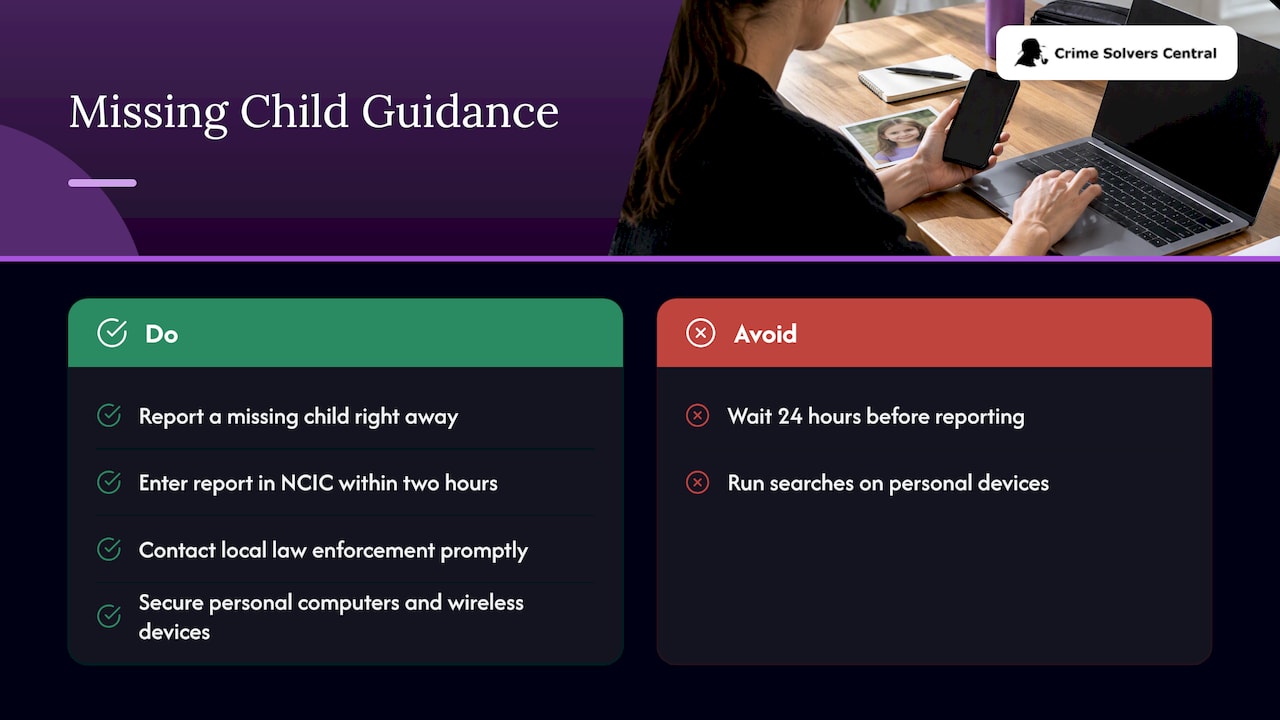
First, there is no waiting period. According to the National Center for Missing & Exploited Children, federal law requires agencies to accept a missing child report right away and to enter it in the NCIC Missing Person File within two hours (34 U.S.C. § 41308), as summarized at missingkids.org. If you see a post telling parents to wait 24 hours, correct it.
Second, guidance for families includes securing devices. NCMEC’s quick reference guide for families tells families to contact local law enforcement as soon as they determine a child is missing. Related advice from NCMEC says to secure personal computers and wireless devices and not to run your own searches on them, since that can corrupt digital evidence. A blog that repeats this is giving readers something they could use on the worst day of their lives.
For a fuller walkthrough, see our guide to missing children: what families and advocates must know.
Our perspective: a blog should move a case forward
We built Crime Solvers Central around a simple belief: attention is only useful if it reaches someone who can act on it. A large audience reading about a case helps nobody if the post has errors, hides the investigating agency or treats the family as a plot device.
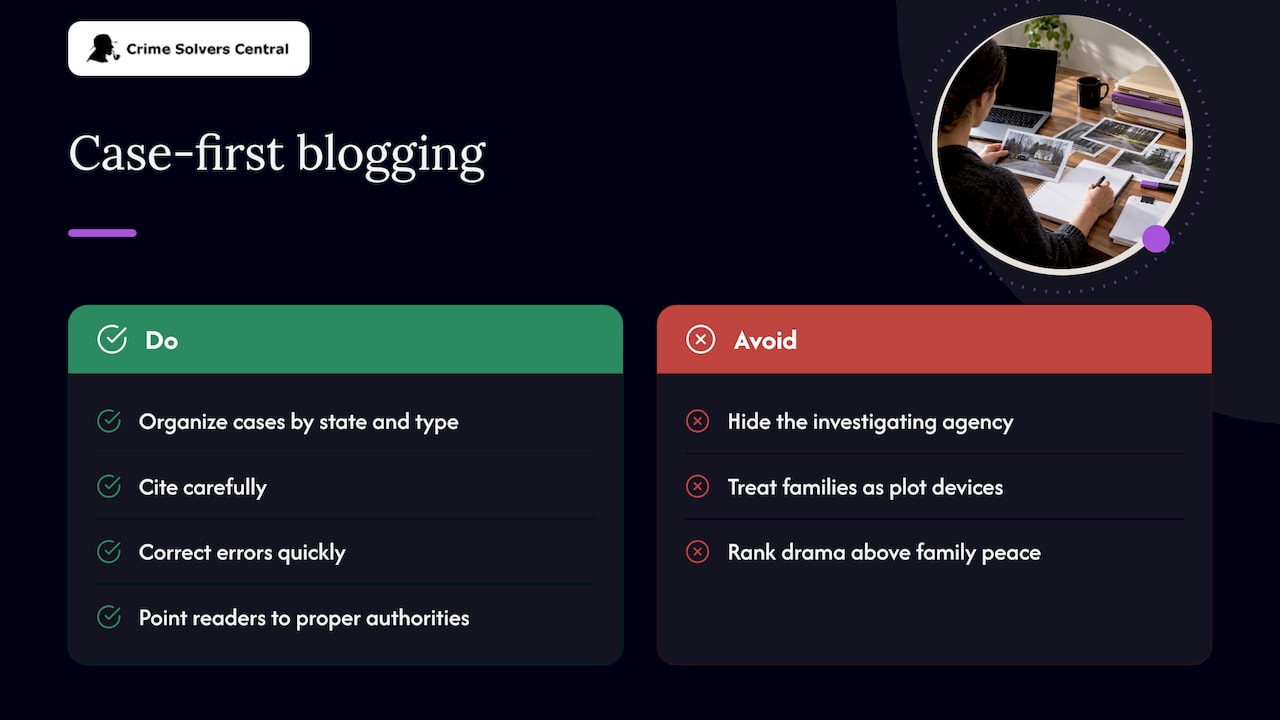
Here is how we think about it. A case catalog should be organized so a reader can find a case by state and type, not only by the ones that went viral. Forgotten victims, those without a podcast or a documentary, are often the ones who most need a visitor to read their profile. Community members should be able to take part through membership, volunteering, fundraising and safety initiatives, and law enforcement should be able to receive public tips through the right channels. Families who have used our resources have shared testimonials about reconnecting and about moving investigations forward, and that is the outcome we measure ourselves against.
For bloggers, that means this: write the post you would want a stranger to write about someone you love. Cite carefully, correct quickly and always point readers to the proper authority. Do not rank a case’s drama above a family’s peace.
— Crime
Build your blog in seven steps
- Pick a narrow beat. One state, one case type or one process.
- Write your ethics page first. Publish your rules on naming, images, corrections and family contact.
- Set a source standard. Primary records first, news second, social media never alone.
- Create a post template. Use the table above so every post answers the same questions.
- Schedule updates. Revisit active cases monthly and mark the date.
- Add a tip path. Link to the investigating agency, not your inbox.
- Measure usefulness. Track not only views but corrections made, tips routed and reader questions answered.
When readers want to go beyond your posts, point them to a place where they can dig into full case files and join a community with rules.
For readers who want to do more than read
If your interest in true crime goes past blogs, a Crime Solvers Central membership unlocks full case details, sources, videos, forums, digital evidence boards, a flyer builder, AI image tools and volunteer coordination. Plans on the pricing page are Jr. Detective at $3.97 per month or $39 per year, Sr. Detective at $9.97 per month or $99 per year, and True Crime Influencer at $39.97 per month or $399 per year. Free summaries and guides remain available on the site, and you can start with the state-by-state database.
FAQ
Do I need journalism training to run a true crime blog?
No, but you need a journalist’s habits. Verify claims, cite records, correct errors and avoid speculation about living people. The OVC’s guide for journalists on reporting about crime and victims is a free starting point.
Can I write about an unsolved case without hurting the investigation?
Yes, if you stick to public information and avoid publishing theories or names that investigators have not confirmed. Do not claim to have solved a case on your own. If you have information, send it to the investigating agency, not just to your readers.
Should I contact a victim’s family before posting?
It is respectful to ask, and many families will say yes if you are clear and honest. If they decline or ask you to go through a spokesperson, follow that wish. Advocacy guidance recommends families name one spokesperson for exactly this reason.
How do I know if a missing persons post is still accurate?
Check the date, then check the investigating agency or an official database. Cases can resolve without the original post ever being updated. Our guide to verifying recent cases before sharing walks through the steps.
Is a database total the same as the number of people missing in the US?
No. Each database covers only the records reported to or collected by it. NamUs, for example, says its reports cover only people reported to NamUs. Always say which database your number comes from.
Sources
- Privacy & Dignity: A Guide to Interacting With the Media, Office for Victims of Crime
- Guide for Journalists Who Report on Crime and Crime Victims, Office of Justice Programs
- The ‘CSI Effect’: Does It Really Exist?, National Institute of Justice
- NamUs Monthly Case Report, December 2025
- NamUs Year in Review Infographic, FY 2025
- National Center for Missing & Exploited Children
- Missing-Child Emergency-Response Quick Reference Guide for Families, NCMEC