

Missing Person Tips for Families and Investigators

Start a secure case file, file a missing-person report with local law enforcement immediately, and register the case in NamUs and NCIC without delay. Those three actions, taken together in the first hours, give investigators the widest possible set of tools to work with.
Immediate priority checklist:
- Call local law enforcement now. There is no waiting period to file a missing-person report in the U.S.
- Ask the officer to enter the case into NCIC and get the case number in writing.
- Secure the missing person’s phone, recent photos, and last-known location data before anything is altered.
- Contact close friends, coworkers, and neighbors for last-known information.
- Register the case with NamUs for free forensic services and long-term database matching.
- Create one master case file (digital and physical) and assign one family member to manage it.
Pro Tip: Make encrypted backups of all digital evidence immediately — screenshots, call logs, social media activity — and store copies in at least two separate locations. Do not alter or factory-reset any device.
One caution: never post your personal phone number on public flyers or social media. Route all tips to a law enforcement tip line or a controlled intake channel instead.

Crimesolverscentral maintains a searchable cold-case database with a vast number of cases organized by state, offering member tools for building case boards and coordinating outreach.
Table of Contents
- What are the most important missing person tips for the first 48 hours?
- How do you preserve digital and physical evidence right away?
- How do NamUs and national databases actually help your case?
- How should families work with law enforcement and victim advocates?
- How do you keep a cold case active over months and years?
- Where can families find emotional support and advocacy?
- How do you build a secure, organized case file?
- Key Takeaways
- What families and investigators often get wrong
- Crimesolverscentral gives investigators and families real tools
- Useful sources
- FAQ
What are the most important missing person tips for the first 48 hours?
The OJJDP Family Survival Guide is direct: the first 48 hours are the most critical window for law enforcement to deploy maximum resources. Every hour of delay narrows investigative options.
Critical window: OJJDP guidance emphasizes that proactive family cooperation and correct national database registration in the first 48 hours are essential to keeping investigative momentum.
Follow these steps in order:
- File the report immediately. Walk into the nearest police station or call 911. Bring a recent photo, physical description, last known location, and any medical conditions or medications.
- Confirm NCIC entry. Ask the officer directly: “Has this case been entered into NCIC?” Get confirmation in writing. If the answer is unclear, ask to speak with a supervisor.
- Contact close contacts. Reach out to friends, coworkers, neighbors, and anyone the person saw recently. Social media review and outreach to acquaintances often surface the last-known location before investigators can.
- Gather recent digital activity. Pull phone records, banking activity, and social media logins. Preserve everything before accounts are locked or data expires.
- Request classification. Tell the officer about any medical issues, mental health conditions, or signs of foul play. This affects how the case is classified and what resources are assigned.
- Escalate if needed. If local law enforcement cannot provide an investigator or NCIC confirmation, ask for the state police or request FBI involvement for cases involving suspected abduction or interstate travel.
For cases involving minors, child-specific guidance covers additional NCMEC resources and law enforcement protocols.
How do you preserve digital and physical evidence right away?
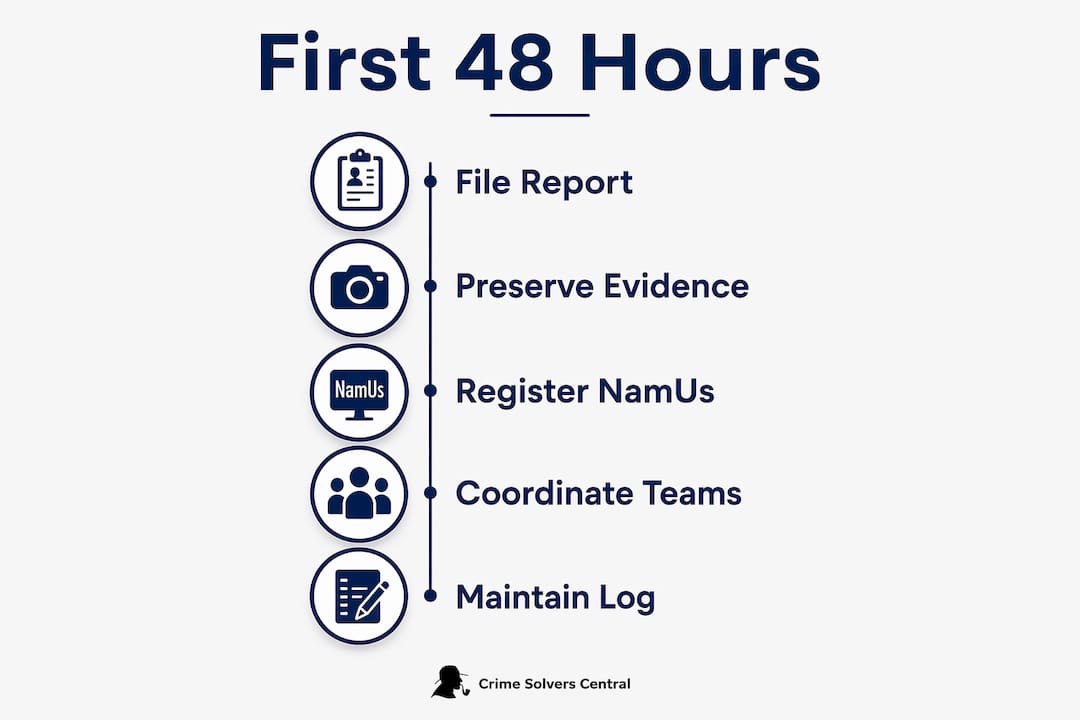
Treat digital evidence the same way a forensic lab would: time-sensitive, chain-of-custody required, no alterations. Families who act on this in the first hours often provide investigators with leads that would otherwise disappear.
Items to secure immediately:
- The missing person’s phone(s), laptop, and tablet. Do not unlock, reset, or charge them without guidance from law enforcement.
- Screenshots of recent social media activity, including DMs, location check-ins, and follower lists.
- Call logs and text message histories, with timestamps preserved.
- Recent photos (within the last 30 days), including metadata showing date and location.
- Vehicle status: mileage, GPS history, and last known location.
- Medication lists and prescription records.
- Banking and credit card activity from the past 30 days.
Pro Tip: Use a free tool like Google Drive or an encrypted app like Tresorit to back up digital evidence. Name each file with a date and description (e.g., “2026-06-15_Instagram_DMs_screenshot”) so investigators can follow the chain of custody without confusion.
NamUs provides free family DNA kits for long-term forensic matching. Request one early, even if you expect a quick resolution. For detailed guidance on preserving physical evidence at home, see evidence preservation steps.
| Evidence Type | Why It Matters | Who Requests It |
|---|---|---|
| Recent photos | Age progression, identification | Law enforcement, NamUs |
| Medical/dental records | Unidentified remains matching | Medical examiner, NamUs |
| DNA sample (family) | Long-term forensic matching | NamUs Analytical Division |
| Phone/location data | Last-known whereabouts | Investigators, prosecutors |
| Financial records | Movement and contact patterns | Detectives, FBI |
How do NamUs and national databases actually help your case?
Registering in both NamUs and NCIC multiplies resolution chances because each system reaches different audiences and uses different forensic workflows. NCIC is a law-enforcement-only database; NamUs is publicly accessible and includes a forensic services division that works directly with families.
NamUs offers free DNA analysis, forensic odontology, and case matching against unidentified remains across jurisdictions. Families can upload photos, physical descriptors, medical and dental records, and DNA family information directly. The NamUs Analytical Division actively works to locate next of kin and conduct DNA comparisons.
Pro Tip: Assign one person on your team to manage NamUs entries. Inconsistent or duplicate records slow down matches. Cross-check your NamUs entry against what law enforcement entered in NCIC to make sure physical descriptors are identical.
State clearinghouses add a third layer. Most states maintain their own missing-persons databases that feed into national systems. Ask your investigator which state clearinghouse covers your jurisdiction and confirm the case appears there.
| System | Who Can Access | Key Function |
|---|---|---|
| NCIC | Law enforcement only | National alert and interagency coordination |
| NamUs | Public, families, researchers | Forensic services, unidentified remains matching |
| State clearinghouse | Varies by state | Regional coordination and referral |
For a deeper look at how these databases work, database mechanics explained covers privacy, visibility, and case integration.
How should families work with law enforcement and victim advocates?
Your job in every interaction with law enforcement is to keep communication organized and to leave with verifiable identifiers. Get the following in writing at first contact:
- Case number
- Assigned investigator’s name, direct phone, and badge number
- Unit handling the case (missing persons, homicide, patrol)
- Written confirmation of NCIC entry
Ask these questions directly: Has the case been entered into NCIC? Are forensic resources available? Is there interagency cooperation with state police or FBI? How are tips being received and logged?
NAMI guidance notes that families can request an endangered adult listing in NCIC if a person has been missing for more than three days and has known health or safety vulnerabilities. Don’t wait to ask.
Red flags that should trigger escalation: no NCIC entry after 48 hours, inability to provide an assigned investigator, or conflicting information about available resources. In those cases, contact the state police, request a NCMEC review, or reach out to a victim advocate through your state’s victim services office.
Pro Tip: Keep a running log of every call and meeting with law enforcement: date, time, who you spoke with, what was said, and what was promised. This record becomes critical if you need to escalate or if the case goes cold.
How do you keep a cold case active over months and years?
Schedule planned case reviews, update NamUs entries regularly, and sustain controlled public awareness. Cases go cold not because evidence disappears but because no one is pushing.
Periodic review schedule:
- 30 days: Re-check all evidence, confirm NCIC and NamUs entries are current, submit any new digital or forensic data.
- 6 months: Request a case status update from the assigned investigator. Push a fresh media release with updated photos. Consider age-progression imaging.
- Annually: Request forensic retesting if technology has advanced (DNA, isotope analysis, forensic odontology). Run a targeted social media campaign with updated materials.
Long-term visibility campaign checklist:
- Update missing-person flyers with new photos and current contact information (tip line only, not personal numbers).
- Coordinate with law enforcement before any media push to avoid compromising active leads.
- Use hashtags and online missing-persons groups to extend reach.
- Organize community events: vigils, awareness walks, and fundraisers keep the case in public view.
- Request specialist coordination through Crimesolverscentral membership tools for volunteer and outreach management.
For sustained campaign strategy, amplifying overlooked cold cases covers media coordination and community engagement in detail.
One legal note: never publish sensitive medical details or personal contact information in public appeals. Share only what law enforcement has approved, and route all tips to a controlled intake channel.
Where can families find emotional support and advocacy?
Seek a family advocate and mental-health support early. Families who have dedicated support sustain better engagement with investigators over the long term.
Key resources:
- NAMI: Mental health guidance, crisis support, and referrals to local services. NAMI also provides specific guidance for families of missing persons with mental health histories.
- NCMEC: 24/7 tip intake, search coordination, and family advocacy for cases involving minors.
- State victim services: Most states fund victim advocates who can accompany families to law enforcement meetings and help navigate legal and financial issues.
- Nonprofit search organizations: Groups like the Black and Missing Foundation offer specialized support and volunteer mobilization, particularly for underrepresented communities.
- Grief support communities: Peer support groups and community grief events provide structured spaces for families managing long-term uncertainty.
Designate one family member to handle media and law enforcement contact. Another manages the case file. A third handles community outreach. Dividing these roles prevents burnout and keeps each function running when one person needs a break.
How do you build a secure, organized case file?
Build one master encrypted case file and keep a separate controlled public summary for outreach. Every document, contact, and timeline entry lives in one place, with access limited to the core team.
Folder structure:
| Folder | Contents | Primary Requester |
|---|---|---|
| Chronology | Timeline of events, daily log | Investigators, attorneys |
| Communications | Law enforcement contacts, tip log | Family case manager |
| Photos/Media | Recent photos, flyers, age progressions | NamUs, media |
| Medical/Dental Records | Records for forensic matching | Medical examiner, NamUs |
| Financial Records | Banking, credit activity | Detectives, FBI |
| Digital Evidence | Screenshots, metadata, device logs | Investigators |
| Forensic Reports | DNA, odontology, lab results | NamUs, ME office |
Pro Tip: Use VeraCrypt or a similar free encryption tool to protect the master file. Maintain an audit log noting who accessed the file and when. This chain-of-custody record matters if evidence is ever challenged in court.
Crimesolverscentral membership includes secure digital case boards, a flyer builder, and member forums where families and investigators can coordinate entries and share updates. For a step-by-step walkthrough, building a case file covers the full platform workflow.
Avoid the most common operational errors families make during this process by reviewing common search mistakes before you begin.
Key Takeaways
Acting in the first 48 hours, preserving digital and physical evidence immediately, and registering in both NamUs and NCIC are the three steps that most directly determine whether a missing-person case stays active or goes cold.
| Point | Details |
|---|---|
| File the report immediately | No waiting period exists in the U.S.; law enforcement must accept reports right away. |
| Confirm NCIC and NamUs entries | Get written confirmation of NCIC entry and register directly with NamUs for free forensic services. |
| Preserve digital evidence first | Screenshot, back up, and timestamp all digital data before devices are altered or accounts expire. |
| Schedule periodic case reviews | Review at 30 days, 6 months, and annually; request forensic retesting as technology advances. |
| Use Crimesolverscentral tools | Member case boards, flyer builder, and a database of over 264,913 cases support coordinated long-term investigation. |
What families and investigators often get wrong
The conventional wisdom around missing-person cases tends to focus on the first 48 hours as if everything after that is secondary. That framing is wrong, and it costs families real investigative traction.
The cases that get resolved after months or years almost always share one trait: someone kept pushing. Not emotionally, but organizationally. A well-maintained case file, consistent NamUs updates, and a scheduled review cadence with investigators are what separate cases that stay active from cases that quietly disappear from anyone’s priority list.
The other thing families underestimate is how much the quality of their own records matters. Investigators change. Departments lose files. A family that walks into a meeting with a complete, timestamped, encrypted case file is not just organized. They are the institutional memory of the case. That role is not optional; it is often the only thing keeping the investigation coherent.
Crimesolverscentral gives investigators and families real tools
Most families managing a missing-person case are doing it with a folder of printouts and a group text. Crimesolverscentral is built for something more structured. The platform’s searchable cold-case database covers over 264,913 cases organized by state and case type, with full case profiles available to members. Subscribers get access to secure digital evidence boards, a flyer builder, AI image tools for age progression, member forums for coordinating with other investigators, and volunteer coordination features. For families working a long-term or cold case, that infrastructure replaces the scattered approach with a single, organized workspace. Membership also connects you to fundraising tools and community safety initiatives that keep public awareness alive. If your case is in the database or you want to build the kind of file that actually moves an investigation forward, start with the platform and see what your membership unlocks.
Useful sources
The most essential sources to consult immediately are NamUs, your local law enforcement agency for NCIC entry, and the OJJDP Family Survival Guide.
- NamUs: Free national database with forensic services, family DNA kits, and unidentified remains matching. Register directly or ask your investigator to submit.
- OJJDP Family Survival Guide: Federal guidance on the 0–48-hour checklist, media coordination, NCIC entry, and long-term case management.
- NAMI Missing Loved One Resources: Mental health support, NCIC endangered adult guidance, and referrals to nonprofit search organizations.
- LegalClarity: What to Do When a Person Goes Missing: Covers the no-waiting-period rule, legal authority for financial access, and guardianship processes by state.
- OJP Missing Loved One Guide: Practical steps for the first days through 30-plus days, with specific guidance for American Indian and Alaska Native families.
- Crimesolverscentral resources: Report filing guide, case-file building walkthrough, and the platform landing page for membership and database access.
| Source | What It Provides |
|---|---|
| NamUs | Free forensic services, DNA kits, unidentified remains database |
| OJJDP Family Survival Guide | 48-hour checklist, NCIC guidance, media coordination |
| NAMI | Mental health referrals, endangered adult NCIC guidance |
| LegalClarity | No-waiting-period rule, legal authority steps |
| Crimesolverscentral | Case database, member tools, flyer builder, evidence boards |
This article provides general information for families and investigators and is not a substitute for legal or professional advice. Confirm current procedures with your local law enforcement agency, NamUs, or a qualified attorney for your specific situation.
FAQ
Is there a waiting period before filing a missing-person report?
No. There is no legal waiting period in the U.S.; law enforcement must accept a missing-person report immediately, regardless of the person’s age.
What does NamUs actually do for families?
NamUs provides a free national database, forensic services including DNA analysis and odontology, and family DNA kits to help match long-term missing persons with unidentified remains across jurisdictions.
How do you confirm a case is in NCIC?
Ask the responding officer directly for written confirmation of NCIC entry. If you cannot get confirmation within 48 hours, ask to speak with a supervisor or contact the state police.
What should you never post on public missing-person flyers?
Never post personal family phone numbers or sensitive medical details. Route all tips to a law enforcement tip line or a controlled intake channel, as OJJDP guidance recommends.
How can Crimesolverscentral help with a cold case?
Crimesolverscentral gives members access to over 264,913 searchable case profiles, secure digital evidence boards, a flyer builder, and member forums for coordinating with other investigators and families.