

Jane Doe Database: How to Search and Submit Tips
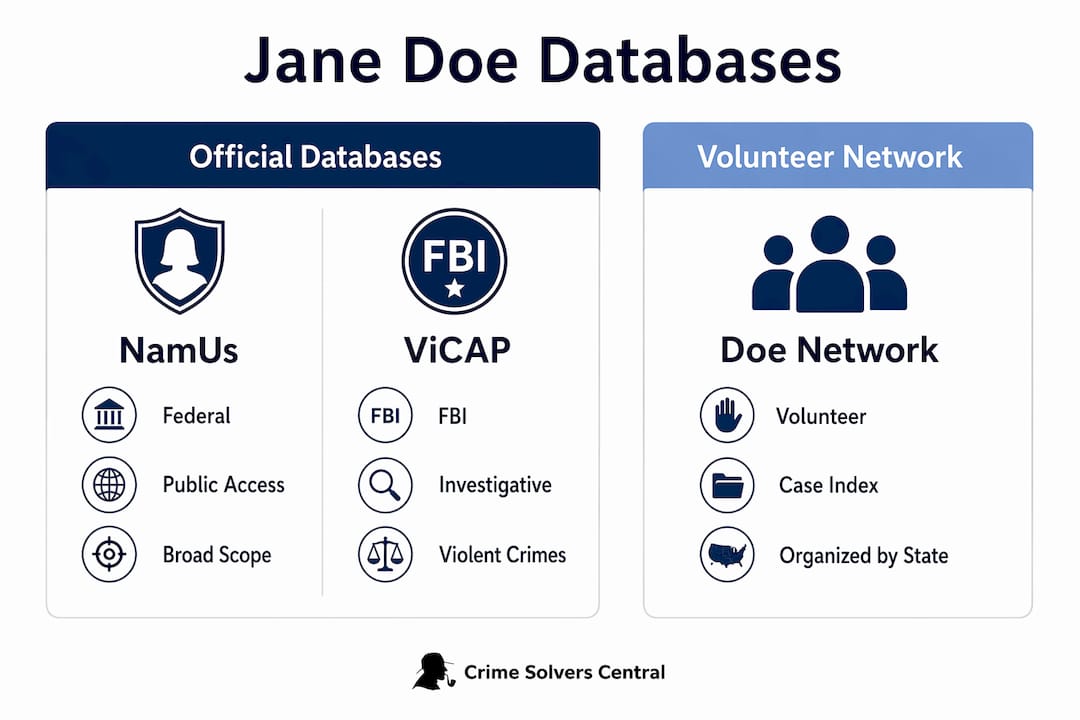
Start your search at NamUs, the only centralized, federally funded national database for unidentified, missing, and unclaimed persons in the United States. For cross-jurisdictional investigative linkage, check ViCAP (the FBI’s Violent Criminal Apprehension Program). For volunteer-sourced case visibility, The Doe Network rounds out the core trio. Before you open any of these systems, gather the basics: a photo if available, estimated age, height, weight, last-known location, and any distinguishing marks. That preparation alone cuts search time significantly.
Here is what to do right now:
- Open NamUs at namus.gov and run an unidentified persons search using the physical descriptors you have.
- Check ViCAP at fbi.gov/wanted/vicap/unidentified-persons for cases with a violent-crime or homicide context.
- Browse The Doe Network (doenetwork.org) for state-organized listings and community-sourced case notes.
- Document every result with a case number, database name, and date searched so you can track follow-ups.
- Crimesolverscentral complements these official systems with over 264,913 searchable cases, state filters, and community tools. More on that below.
Table of Contents
- What Jane Doe database should you search first?
- How do you search a Jane Doe database effectively?
- What fields will you see in a Jane Doe case file?
- How do you submit a tip or request records from official systems?
- What these databases can’t do, and why cases stay unresolved
- How Crimesolverscentral complements official databases
- Key Takeaways
- The gap between what databases promise and what actually moves a case forward
- Crimesolverscentral: organized tools for families and volunteers
- Useful sources
- FAQ
What Jane Doe database should you search first?
The right database depends on what you already know and what access you have.
NamUs: the national standard
NamUs is the only federally funded, searchable national database covering missing, unidentified, and unclaimed persons across all U.S. jurisdictions. Administered by the National Institute of Justice, it offers no-cost forensic services and investigative support to both law enforcement and families. The public can run basic searches without an account. Registered users, including law enforcement and medical examiners, get access to full case files, advanced Boolean queries, and CSV export. If you are a family member or volunteer starting from scratch, NamUs is the right first stop.
ViCAP: built for investigators
ViCAP is the FBI’s national repository for behavioral and investigative data on major violent crimes, including cases involving unidentified human remains. It is designed for cross-jurisdictional linkage, meaning it helps investigators connect similar cases across state lines. Public access is limited to a browsable gallery of unidentified persons at fbi.gov/wanted/vicap/unidentified-persons. If you are a law enforcement officer or working alongside one, ViCAP is where to look for cases with a homicide or violent-crime context.
The Doe Network: volunteer-powered visibility
The Doe Network is a volunteer-run case index organized by state and country. It does not have the forensic depth of NamUs, but it excels at community visibility and volunteer coordination. Cases are cross-referenced with NamUs and other official sources, and the site accepts tips from the public. For families who want their case seen by a wider volunteer community, submitting to The Doe Network increases exposure beyond official channels.
State and local medical examiner pages
Not every unidentified remain makes it into a national system quickly. State and local medical examiner (ME) and coroner offices often maintain their own listings, and a case may appear there weeks or months before it is entered nationally. The role of coroners in this pipeline matters: they are frequently the first point of contact for unidentified remains, and contacting your county or state ME directly can surface cases that have not yet been uploaded.
| Database | Operator | Public Access | Best For |
|---|---|---|---|
| NamUs | National Institute of Justice | Yes (basic search) | National searches, family submissions, forensic services |
| ViCAP | FBI | Browsable gallery only | Violent-crime linkage, investigator cross-referencing |
| The Doe Network | Volunteer organization | Yes (full browse) | Community visibility, volunteer tips, state-organized listings |
| State/Local ME pages | County or state agencies | Varies | Recently recovered remains, pre-national-entry cases |
How do you search a Jane Doe database effectively?
A targeted search beats a broad one every time. Here is a numbered checklist to work through before and during your search.
- Gather your materials first. Collect any photos, a timeline of last-known contact, last-seen location, medical or dental records, known tattoos or scars, and whether family DNA is available. The more specific your inputs, the tighter your results.
- Set realistic age and date ranges. NamUs lets you search by estimated age range and recovery date. Use a window of plus or minus five years on age and a broad date range if you are uncertain when a person went missing.
- Prioritize distinguishing features. NamUs search fields include estimated age, height, weight, manner of death, condition of remains, recovered clothing and items, dental record availability, DNA availability, and distinguishing marks like tattoos or surgical hardware. Start with the most unique features, not the most common ones.
- Filter by geography, then expand. Begin with the state or region where a person was last seen or where you suspect remains were recovered. If that returns nothing useful, expand to neighboring states.
- Use Boolean logic for registered searches. Advanced NamUs queries support “and,” “or,” and “not” operators across every database field. A registered user can run a query like: female AND estimated age 25–35 AND tattoo AND Texas AND recovered 2010–2020. Export results to CSV for offline comparison.
- Cross-reference across systems. A case in NamUs may have additional detail in ViCAP or a state ME listing. Never rely on a single database to rule out a match.
- Document every search. Record the database, filters used, date, and result count. If you return in three months, you need to know exactly what you already checked.
Pro Tip: Combining a database search with public outreach amplifies your reach. If NamUs has a facial reconstruction image attached to a case, download it and share it through community social media groups, local news tips, and missing-persons advocacy pages. A static database record becomes a live lead the moment a real person recognizes a face.
What fields will you see in a Jane Doe case file?
A typical unidentified-person record in NamUs or ViCAP contains more information than most people expect, and knowing how to read it saves time.

Case status is the first field to check. Active means the case is open and the person has not been identified. Archived or resolved means an identification was made or the case was closed for another reason. Here is the catch: archived cases remain visible in NamUs even after resolution, which can confuse searchers who assume every visible record is still open. Always read the status field before investing time in a case.
Physical description fields include estimated age at death (often a range), height, weight, hair color and length, eye color, and body build. These are estimates, not confirmed measurements, so treat them as ranges rather than exact values.
Forensic and medical fields cover dental record availability, DNA availability, cause and manner of death, and condition of remains. When a case shows “dental records available” or “DNA on file,” that means a comparison can be run if a family submits a reference sample. Without that family DNA, the system cannot make a biological match automatically.
Clothing and personal effects are often the most specific identifiers in a cold case. A distinctive jacket, jewelry, or shoe brand can trigger recognition in a way that a physical description alone cannot.
For a deeper breakdown of how to interpret unidentified remains records, the terminology and field definitions can be surprisingly technical.
How do you submit a tip or request records from official systems?
Submitting useful information is different from submitting any information. A vague tip wastes investigator time. A structured one gets acted on.
- For NamUs public submissions: Go to namus.gov, locate the case, and use the “Submit Additional Information” function. You do not need an account to submit a tip on an existing case. Include your contact information, the basis for your belief (what you observed or know), and a confidence level (certain, probable, possible).
- For ViCAP: Public tips go through the FBI’s tip line at tips.fbi.gov or through local law enforcement, who can enter or update a ViCAP case directly. You cannot submit to ViCAP as a private citizen without law enforcement involvement.
- For The Doe Network: Use the contact form on the specific case page. Volunteer case managers review tips and forward credible ones to the assigned law enforcement agency.
- For local ME or coroner offices: Call or email directly. Ask whether the case has been entered into NamUs and whether they are accepting family DNA reference samples. If you are a family member, ask specifically about the process for submitting a biological reference sample for DNA comparison.
- Escalate when necessary. If you believe you have a strong match and are not getting a response, contact the National Center for Missing and Exploited Children (NCMEC) or a victim advocate organization. They can facilitate communication between families and law enforcement.
Tip submission template (copy and adapt):
Pro Tip: Before submitting, review our guide on building a case file to organize your documentation. A well-structured submission with clear evidence references is far more likely to prompt a follow-up than a general inquiry.
Privacy checklist before you submit:
- Do not post case details, photos of remains, or personal family information publicly before consulting law enforcement.
- Use a dedicated email address for case correspondence if you prefer not to share personal contact details.
- If you are a volunteer, follow your organization’s protocols for handling sensitive information. Organizations working with volunteers on sensitive cases benefit from nonprofit volunteer screening practices that protect both the volunteers and the families they assist.
What these databases can’t do, and why cases stay unresolved
National databases are powerful, but they have real limits that every searcher needs to understand.
The most fundamental constraint is that database effectiveness depends entirely on the quality and quantity of data submitted by local, state, and tribal law enforcement. Participation is largely voluntary. A county coroner who does not enter a case into NamUs means that case simply does not exist in the national system, regardless of how thorough the national database is otherwise. Rural jurisdictions, underfunded offices, and agencies with high caseloads are the most common sources of gaps.
Databases also do not automatically cross-match cases. The system can flag potential matches when data overlaps, but a confirmed identification requires a human investigator to review the match and, in most cases, a biological comparison (DNA or dental) to confirm it. Families sometimes assume that submitting a missing-person report automatically triggers a search against unidentified remains. It does not, at least not without a family DNA reference sample entered into the system.
Statistic callout: A Department of Justice audit found that ViCAP submissions increased nearly 3,000% between fiscal years 2018 and 2023. That growth exposed technology and resource constraints that can slow quality control and investigative linkage, meaning more cases in the system does not automatically mean faster resolutions.
Archived cases add another layer of confusion. A resolved case stays visible in NamUs, which means a search can return dozens of records that are technically closed. Always check the status field first and filter for active cases when you want to focus your effort.
Pro Tip: When database coverage is sparse for a specific region or time period, shift your outreach strategy. Contact the state ME office directly, reach out to regional cold-case units, and post in local community groups. Sparse database coverage often means the case exists somewhere in a paper file, not that it does not exist at all.
How Crimesolverscentral complements official databases
Official databases are the foundation. Crimesolverscentral is the layer that helps families, volunteers, and investigators organize, amplify, and act on what those databases contain.
With a large number of cases cataloged and organized by state and case type, Crimesolverscentral gives users a structured starting point that cuts through the volume of national records. The platform’s tools are built specifically for the people doing this work day to day.
What members get access to:
- State-filtered case profiles covering missing persons, unsolved homicides, and unidentified/unclaimed remains, so you can focus on a specific geography without running multiple database queries.
- Full case files with sources, videos, and evidence boards that go beyond the summary-level data available in public NamUs searches.
- A flyer builder and AI image tools for creating shareable identification materials from case photos or forensic reconstructions.
- Volunteer coordination features that let community members work together on outreach without duplicating effort.
- Forums and community engagement where families and investigators can share leads, ask questions, and coordinate follow-ups.
The practical use cases are straightforward. A family searching for a missing relative can use Crimesolverscentral to organize their documentation, build a shareable flyer, and connect with volunteers who can amplify the case on social media. A volunteer investigator can use the state filters to identify unresolved cases in a target region, then cross-reference those against NamUs and ViCAP. An investigator looking for organized leads and public-facing materials can use the evidence boards and case profiles to build a working file.
Crimesolverscentral does not replace NamUs submissions or ViCAP entries. It works alongside them, providing the community infrastructure and organizational tools that official systems are not designed to offer. For more on how community databases and official systems work together, see why cold case databases matter.
Key Takeaways
NamUs, ViCAP, and The Doe Network form the core of any Jane Doe search in the U.S., and effectiveness depends on the quality of data you bring in and the specificity of the tip you submit.
| Point | Details |
|---|---|
| Start with NamUs | The only federally funded national database; allows public searches and family DNA submissions. |
| ViCAP for violent-crime cases | FBI-operated; best for cross-jurisdictional investigative linkage; requires law enforcement involvement to submit. |
| Prepare before you search | Gather photos, age estimates, distinguishing marks, and dental or DNA availability before opening any database. |
| Gaps are real | Database coverage depends on voluntary local submissions; contact state ME offices directly when national results are sparse. |
| Crimesolverscentral adds reach | Over 264,913 cases with state filters, flyer builder, and volunteer coordination tools that complement official submissions. |
The gap between what databases promise and what actually moves a case forward
The conventional wisdom says: enter the data, run the search, wait for a match. Anyone who has spent real time working these cases knows that is not how it works.
The databases are only as good as the humans feeding them. A Jane Doe recovered in a rural county in 2003 may have a paper file in a coroner’s office and nothing else. No NamUs entry. No ViCAP record. No Doe Network listing. The national system has no idea she exists. That is not a failure of the technology. It is a failure of the pipeline, and it is far more common than the official statistics suggest.
What actually moves cases forward is the combination of persistent public outreach and structured documentation. A facial reconstruction shared in the right Facebook group has identified people that years of database searching could not. A family member who calls the county ME every six months keeps a case from going completely cold. A volunteer who builds a well-organized tip submission, with photos, a timeline, and a clear confidence statement, gives an overworked investigator something they can actually act on.
The databases are tools. The people using them are the engine. If you are searching for someone, do not wait for the system to produce a match. Work the system, work the community, and document everything.
Crimesolverscentral: organized tools for families and volunteers
Searching NamUs, ViCAP, and The Doe Network gives you the official record. What most families and volunteers need next is a way to organize what they find, build shareable materials, and connect with others working the same geography. That is exactly what Crimesolverscentral is built for.
With more than 264,913 cases indexed by state and case type, the platform gives you a structured view of cold cases that official databases do not offer in one place. Members get full case files, a flyer builder for creating identification materials, AI image tools, volunteer coordination features, and community forums where leads get shared and followed up.
- State filters let you focus on a specific region without running multiple queries across separate systems.
- Volunteer coordination tools prevent duplicated outreach and keep community efforts organized.
If you are a family member, a volunteer investigator, or someone who has found a potential match in an official database and needs help building a case, start at Crimesolverscentral and see what the full case file and community tools can add to your search.
Useful sources
The sources below are the primary authoritative references for the claims in this article. Each is a government or official organization resource.
| Source | What It Provides |
|---|---|
| NamUs (NIJ) | Federally funded national database for missing, unidentified, and unclaimed persons; no-cost forensic services |
| NamUs Advanced Search Guide | Step-by-step instructions for Boolean queries, field-level searching, and CSV export for registered users |
| NamUs FAQ | Official explanations of case status, archival practices, and how resolved cases remain visible |
| ViCAP Overview (FBI) | Explains ViCAP’s role as the FBI’s national violent-crime and unidentified-persons repository |
| ViCAP Unidentified Persons (FBI) | Public-facing gallery of ViCAP unidentified persons cases, browsable by the public |
| DOJ ViCAP Audit | Inspector General audit documenting submission growth and resource constraints in ViCAP |
How to verify official status and find local ME pages:
- Look for a .gov domain. NamUs is at namus.nij.ojp.gov; ViCAP is at fbi.gov. Any site without a .gov suffix is not an official government resource.
- To find your state or county ME office, search “[state name] medical examiner unidentified persons” or visit your state’s department of health website and navigate to the medical examiner or forensic services section.
- For volunteer background screening when coordinating community tip collection, volunteer screening resources can help organizations protect both volunteers and the families they work with.
FAQ
What is the best Jane Doe database to search in the U.S.?
NamUs is the most authoritative starting point: it is the only federally funded, searchable national database for unidentified persons and allows public searches without an account.
Can the public submit tips to NamUs directly?
Yes. Anyone can submit additional information on an existing NamUs case without registering; registered users get access to advanced search tools and can submit new case data with law enforcement coordination.
Why does a resolved Jane Doe case still appear in NamUs?
Archived and resolved cases remain visible in NamUs after closure, which is by design for historical and research purposes. Always check the case status field to confirm whether a record is still active.
How does ViCAP differ from NamUs for unidentified persons?
ViCAP is an FBI investigative tool focused on violent-crime linkage across jurisdictions, while NamUs is a broader national clearinghouse open to families and the public. ViCAP submissions require law enforcement involvement; NamUs accepts public tips directly.
How does Crimesolverscentral fit alongside official databases?
Crimesolverscentral catalogs over 264,913 cases with state filters, flyer-building tools, and volunteer coordination features that help families and investigators organize and amplify what they find in official systems like NamUs and ViCAP.