

Where to Find Unidentified Remains and Unclaimed Persons Records
Start with NamUs, the National Missing and Unidentified Persons System. It is the one national database with public access to unidentified, unclaimed and missing persons records. NamUs is administered by the National Institute of Justice, and anyone can search it for free. Then check the state registry and the medical examiner or coroner in the county where the person was found, because no single database holds every case. This guide shows where each record lives, how to search it, what to bring to a phone call and what happens when a person has a name but no one comes forward.
TL;DR
- NamUs has three public databases: Unidentified Persons, Missing Persons and Unclaimed Persons. Search all three, because a person can appear in a different one than you expect.
- NamUs is not a complete census. Reporting is voluntary except where state law requires it, so also check state registries and the local medical examiner or coroner.
- An unidentified person has no known name. An unclaimed person has been named, but no next of kin has been located or has claimed the remains.
- Have dates, physical descriptors, tattoos, clothing, dental and medical details ready before you call. Missing-person reports go to law enforcement.
- Our members get full case files, forums and tools to organize what they find, starting at $3.97 per month.
Table of Contents
- Unidentified versus unclaimed: two different searches
- NamUs: the first place to search
- Beyond NamUs: state, county and agency records
- Reading a case record
- What to have ready before you call
- What happens to an unclaimed person
- A search plan you can follow this week
- Our perspective
- Take your search further with a membership
- FAQ
- Sources
Unidentified versus unclaimed: two different searches
The two terms sound alike, but they send you to different records.
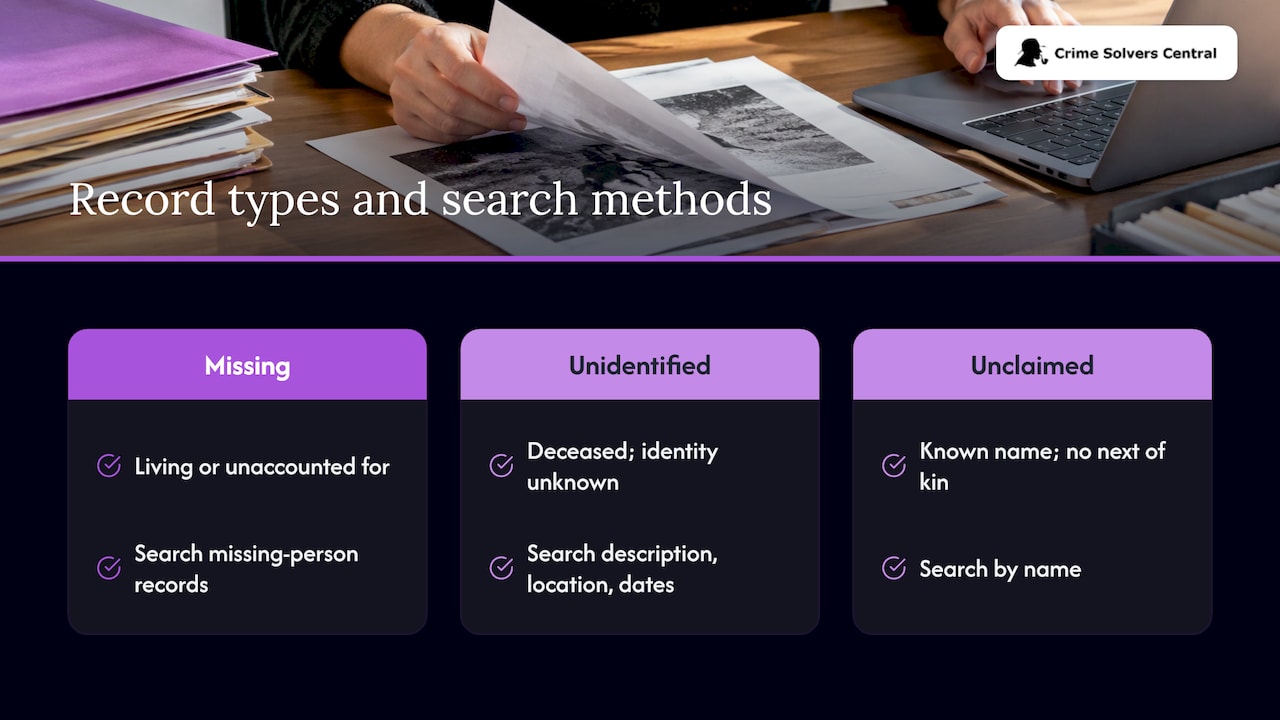
Unidentified persons. Wayne County, Michigan defines an unidentified person as a deceased person whose identity the medical examiner cannot determine. You search these records by physical description, location found and approximate dates. There is no name to type in.
Unclaimed persons. The same county describes an unclaimed person as a decedent whose legally recognized next of kin has not contacted a funeral home to make final arrangements. NamUs defines an unclaimed person as someone identified by name for whom no next of kin has been located to receive notification or claim the remains for burial or cremation. These records usually carry a name, so a name search is the right tool.
Missing persons. This is the third category. A missing-person record describes a living or unaccounted-for person whose family or agency is looking for them. Matching missing records against the other two is how many identifications happen.
If you are looking for a relative, search all three. A missing-person entry for your relative and an unidentified-person entry for the person you are trying to match are two halves of the same puzzle.
NamUs: the first place to search
NamUs exists to solve a specific problem. It was built to link communication and data between agencies, so that isolated databases and cases that cross jurisdictional lines stop falling through the gaps. For the public, here is what that means in practice.
- NamUs has three databases that the general public can search: Unidentified Persons, Missing Persons and Unclaimed Persons.
- Public users can search visible case information, track cases and enter missing-person cases. That includes family members, volunteers, advocacy-group staff and the general public.
- Biometric and other secure case information is limited to vetted criminal-justice users, so you will not see everything the investigators see.
- Public case entries are vetted with the investigating agency before they appear. A case you cannot find may simply not have been published yet.
- Records come from medical examiners and coroners across the United States, Guam and Puerto Rico.
The scale is large. As of June 1, 2026, NamUs reported more than 15,000 active unidentified-decedent cases, and its FAQ estimates roughly 4,000 unidentified decedents are recovered nationally, with about 1,000 more added each year. Numbers like these are why a good search strategy matters more than scrolling.
For a screen-by-screen walkthrough, read our step-by-step NamUs search guide for families.
How NamUs matches cases
NamUs automatically compares missing and unidentified cases using dates, geography and core demographic information. You can add descriptors such as scars, marks, tattoos, clothing and jewelry to widen the net. That tells you what to enter: the more specific and distinctive the detail, the more useful the comparison.
Registered users can run advanced searches with searchable fields, pick-lists, keywords and Boolean operators such as “and,” “or” and “not,” within the viewing permissions of their account. If you plan to search more than once, register. Our guide to advanced NamUs searches and records requests covers how to turn a broad list into a short one.
Why a case may disappear
When a NamUs case is resolved, meaning the decedent is identified or next of kin is located, it is archived and no longer publicly viewable, except to attached professional contributors. If a record you bookmarked vanishes, that can be good news. Contact the investigating agency listed on your saved case before assuming something went wrong.
Beyond NamUs: state, county and agency records
NamUs is not federally mandated and does not include every missing, unidentified or unclaimed person in the country. NIJ says the same: reporting is voluntary except where state law requires entry, and published cases do not necessarily represent all cases in any jurisdiction. Plan on checking three more layers.
State registries
Some states run their own searchable systems. Orange County, Florida’s registry points the public to NamUs and to Florida’s statewide FLUIDdb, which can be searched by sex, race, age and the date the person was last reliably known alive. Search for your own state’s equivalent by combining the state name with “unidentified decedent” and “medical examiner.”
County medical examiners and coroners
The office that handled the remains holds the most complete file. Many publish their own lists. Wayne County’s Medical Examiner’s Office has a public search tool, and if you recognize someone there, you should contact its Investigative Department, where you may be asked for identifying characteristics. Cook County, Illinois publishes an unclaimed persons page too, and other large offices do the same.
Smaller counties often have no website tool. A phone call to the coroner or sheriff’s office is the right move there. The South Carolina Coroners Association and similar state associations can point you to the correct office.
Law enforcement and the FBI
The FBI’s Violent Criminal Apprehension Program (ViCAP) collects and analyzes information about homicides, sexual assaults, missing persons and other violent crimes, and it has an unidentified persons component aimed at investigators. You will usually reach it through a detective rather than directly. Our guide on searching beyond NamUs for unidentified persons explains how the national and local layers fit together.
Volunteer-run and community resources
Nonprofit and volunteer groups publish cases and raise awareness, and some focus on specific states or on specific kinds of cases. They are a good complement to official records, never a replacement. Our guide to connecting with families in similar cold cases shows how to register with NamUs first and then reach out.
Reading a case record
When you open an unidentified-person entry, look at these fields first.
| Field | Why it matters |
|---|---|
| Date and location found | Narrows the search to a time window and region |
| Estimated age, sex, height and weight | Ranges are wide, so allow for error |
| Tattoos, scars, piercings, surgical hardware | The most distinctive and most often decisive details |
| Clothing and items found with the person | Can match a last-seen description |
| Dental and medical information | Supports comparison with the records your relative’s dentist or doctor holds |
| Investigating agency and case number | The contact you will need if you think you have a match |
Treat a possible match as a lead, not a conclusion. Photographs and descriptions are imperfect, and identification is made by the medical examiner through scientific comparison. Georgia’s Medical Examiner’s Office lists visual identification, dental comparison, prior medical intervention, unique identifying marks and DNA among the methods that may be used.
What to have ready before you call
A tip is only useful if the office can act on it. Gather this information first.
- Full name and aliases, date of birth and date of last contact. The U.S. Department of Justice model statute lists these along with identifying marks, height and weight, a photo, clothing and items carried, the dentist or physician, and the circumstances.
- Medical and social history, photographs and last known address. NYC’s Office of Chief Medical Examiner says relatives may be asked for these, plus clothing and personal effects.
- Family DNA reference samples. The same office notes it may collect them for comparison through CODIS. Do not collect samples yourself. Ask the agency how it wants them collected.
- Dental and medical providers. Knowing who treated your relative lets the investigators request X-rays and records.
When you contact an office about a listed case, Clark County, Nevada’s public notice shows the preferred format: give the case number and call or email the Coroner/Medical Examiner with any potentially identifying detail, however small.
One point of confusion saves time. NYC’s OCME says it does not directly investigate missing-person reports. Those go to the appropriate law-enforcement agency, while the medical examiner can run scientific and comparative searches against records of deceased people. File the report with police first, then ask the detective to coordinate with the medical examiner. Our missing person tips for families and investigators covers what to say in that first conversation.
What happens to an unclaimed person
An unclaimed person has a name but no one has stepped forward. The details differ by county and state, so treat this as an example of the typical path.
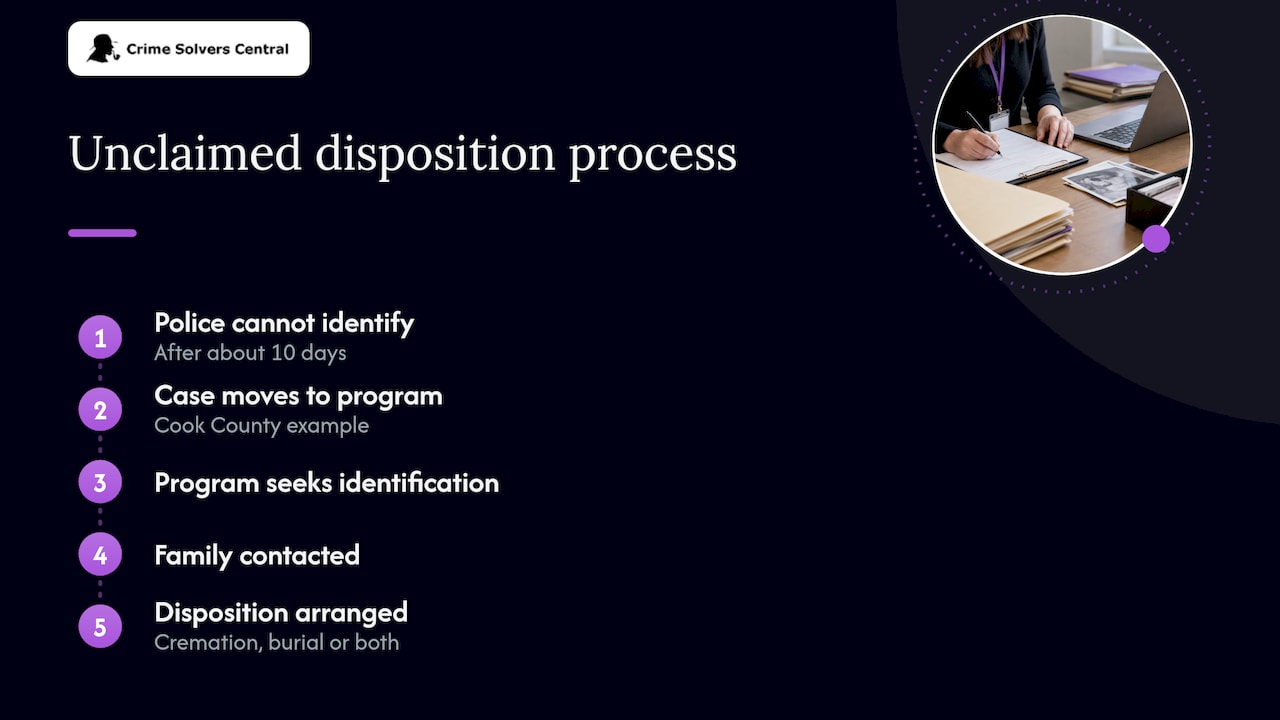
In Cook County, Illinois, reporting by WBEZ explains that when police cannot identify a body in about 10 days, the case moves to the Medical Examiner’s Indigent Disposition Program. That program tries to identify the person, contacts family and arranges cremation, burial or both. Other counties handle it through the coroner, the sheriff or county social services, and waiting periods vary.
The practical lesson is time. If you think a relative may have died and gone unclaimed, call the medical examiner or coroner in the county where they lived or were last seen. Ask whether the office holds a decedent by that name, what its holding period is, and who has legal authority to claim the remains. Our five-step guide to searching unclaimed bodies records walks through that process.
A search plan you can follow this week
- Write down what you know. Use the checklist above and note which details are certain and which are guesses.
- Search all three NamUs databases. Try broad filters first, then narrow by state, age range and distinguishing marks.
- Register with NamUs so you can track cases and run advanced searches. If your relative is missing and not yet listed, ask law enforcement to confirm a report is on file.
- Check the state registry and the county medical examiner or coroner pages for where the person was last seen and for neighboring counties.
- Call, with a case number. Share only what you have, in the way the office asks.
- Keep a log. Record dates, names, case numbers and what each office said. Cold cases move slowly, and a log keeps follow-ups sharp.
If you are searching by name rather than description, our guide to searching cold cases by name goes from NamUs to a national index in six steps. A broader overview of federal missing persons resources is also useful when you are not sure which agency to start with.
Our perspective
Families rarely fail to search because they do not care. They stall because the records are scattered across federal, state and county offices, and no one hands them a map. We built Crime Solvers Central to be that map.
Our national database covers more than 264,000 cold cases, including missing persons, unsolved homicides and unidentified or unclaimed remains, and every case is sorted by state and situation. That structure matters when you are checking one county after another and trying to remember what you already ruled out.
We believe official databases such as NamUs are the foundation, and we encourage every family to use them first. What we add is the working space around them: full case files, sources and videos for members, forums, digital evidence boards, a flyer builder, AI image tools and volunteer coordination. Our testimonials show what happens when a community pools its attention on a forgotten case.
A name returned to a person is the goal. Organized, patient, shared effort is how we get closer to it.
Crime
Take your search further with a membership
Once you have searched the official records, you need somewhere to keep what you find and people to work through it with. Crime Solvers Central members unlock complete case files, forums, digital evidence boards and a flyer builder. Our plans are listed below.
| Plan | Monthly | Yearly |
|---|---|---|
| Jr. Detective | $3.97 | $39 |
| Sr. Detective | $9.97 | $99 |
| True Crime Influencer | $39.97 | $399 |
You can also browse the cold case database by state before you decide. For more on who we are, see our about page.
FAQ
Is there a database for unidentified bodies?
Yes. NamUs is the national database, and its Unidentified Persons records are searchable by the public for free. Some states also run their own registries, and county medical examiners publish additional lists. Because reporting is not universal, check more than one source.
Can I get a list of unidentified people?
You can browse the NamUs Unidentified Persons database and filter by state, sex, age range and date found. Wayne County, Orange County and other local offices publish their own registries. Sensitive details are restricted to authorized professionals, so the public view is a summary.
What happens to unclaimed, unidentified bodies?
The medical examiner or coroner keeps trying to identify the person through dental, DNA, fingerprint and other methods. If no one claims the remains after the office’s holding period, the county generally arranges burial or cremation. Waiting periods and practices vary by county, so ask the local office.
How do I find out information about someone who has died?
If you think the person died in a particular county, contact that county’s medical examiner or coroner. Search the NamUs Unclaimed Persons records by name. Law enforcement can also confirm whether a death was reported and who has been notified.
What should I do if I think I recognize an unidentified person?
Contact the investigating agency or medical examiner listed on the case, and give the case number. Share any identifying detail, such as a tattoo, a scar or a last-seen description. The agency will confirm identity through scientific comparison.
Sources
- National Missing and Unidentified Persons System, NIJ
- Frequently Asked Questions, NamUs
- What is NamUs?
- NamUs home page
- NamUs, NYC Office of Chief Medical Examiner
- Missing and Unidentified Persons, NYC OCME
- NamUs User Guide: Advanced Search and Export
- Unclaimed and Unidentified Persons Search, Wayne County
- Unidentified Decedent Registry, Orange County, Florida
- Model State Missing Persons Statute, DOJ
- Unidentified/Missing Persons, Georgia Bureau of Investigation
- Coroner’s Office Seeks Public’s Help, Clark County, Nevada
- What happens to unidentified or unclaimed bodies in Cook County, WBEZ