

Crime News: How to Read It, Verify It and Act on It

Crime news is the daily reporting of arrests, investigations, court cases and public safety warnings, from a local burglary to a federal fraud indictment. The best way to use it is to know where reliable reports come from, to separate what is confirmed from what is only alleged, and to know what to do when a story touches someone you love. This guide covers all three, with a focus on missing persons and cold cases, where headlines fade long before the families do.
TL;DR
- Crime news covers far more than police blotters: arrests, indictments, pleas, trials, sentencing and the long tail of unsolved cases.
- An indictment is an allegation, not a finding. Defendants are presumed innocent until proven guilty.
- Check official sources first (federal agency press pages, court records, the FBI’s Crime Data Explorer), then compare with local reporting.
- Heavy coverage of homicide and sensational cases can make crime feel more common than the data show.
- If you have information about a crime, call 911 for emergencies and use the local agency or a tip line for everything else. Never post suspicion as fact.
Table of Contents
- What crime news actually covers
- Where to find reliable crime news in the United States
- Confirmed, developing or alleged: how to read a crime report
- Why crime news can distort what you think is happening
- Following missing-person and cold-case news
- Sharing information with investigators the right way
- Victims and the justice system in the headlines
- Using crime news for study: a guide for students
- Our perspective: crime news needs a second chapter
- Work cold cases with us
- FAQ
- Sources
What crime news actually covers
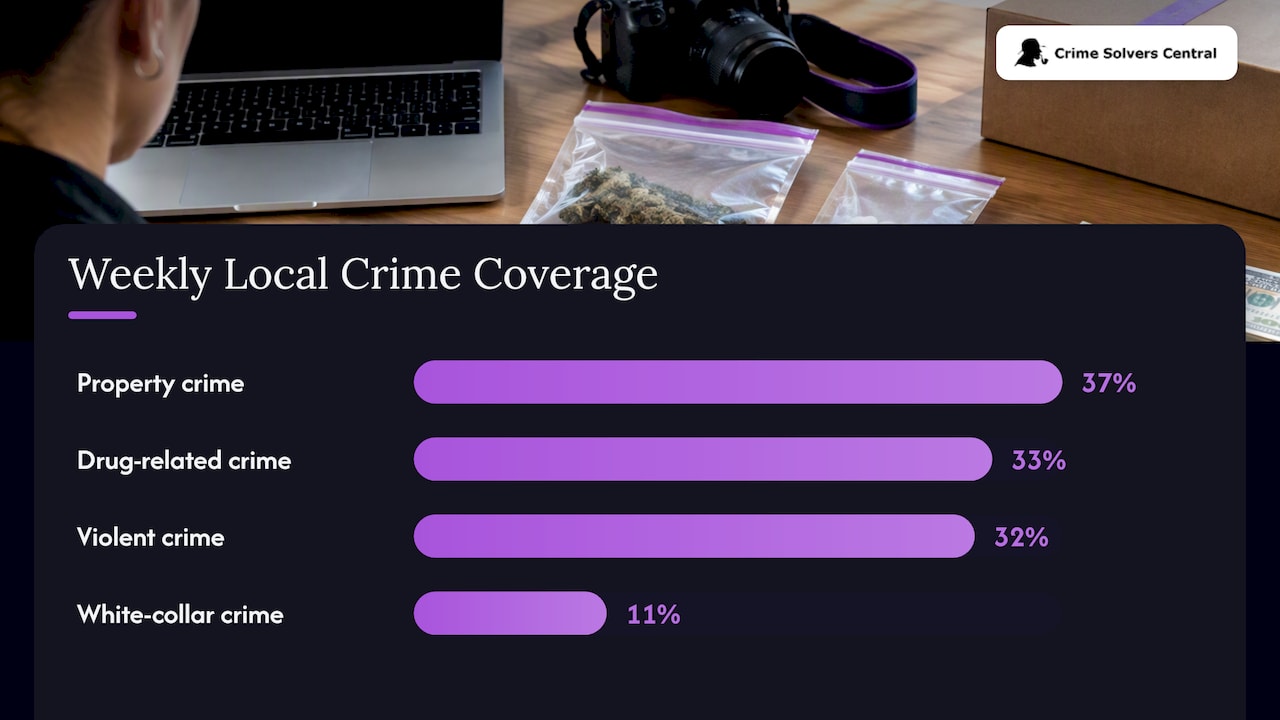
Most people picture a police report read aloud on the evening broadcast. The real range is wider. Pew Research Center’s 2024 survey of local crime coverage found that 37% of U.S. adults saw or heard local news about property crime at least weekly, versus 33% for drug-related crime, 32% for violent crime and 11% for white-collar crime. The same research shows readers want more than the incident itself: what happened and why, what local officials are doing, what causes and patterns sit behind it, and what safety steps they can take.
Good reporting follows a case past the first arrest. NewsLab’s guide to the beat says crime reporting reaches through courts, sentencing, prisons and community trends, not just the initial incident. In practice a single case can generate stories at five or six stages:
- The incident and first police statement.
- An arrest or a named person of interest.
- Charges or an indictment.
- Pleas, trial and verdict.
- Sentencing and appeals.
- Years later, a cold-case review, a new tip or DNA result.
The federal side has its own rhythm. The U.S. Courts’ journalist guide explains that criminal cases are about government allegations that a person or entity violated criminal law, and that many high-profile cases begin as federal investigations led by a U.S. attorney’s office with agencies such as the FBI, DEA or SEC. If a headline mentions a grand jury, an unsealed indictment or a plea agreement, you are reading about that federal track.
Crime coverage today also lives well beyond newspapers. Nieman Lab’s look at the field a decade after the podcast Serial notes that stories about murder and war crimes now run across news, podcasts, television and social platforms. That spread is why the same case can reach you as a polished documentary, a local broadcast clip and an unverified social post within a single afternoon, each with a different standard of care.
Where to find reliable crime news in the United States
Start as close to the source as you can, then widen out.
Official federal pages
The FBI runs a violent crime news page with press releases that you can filter by category, including bank robbery, crimes against children, gangs and human trafficking. Federal press releases are written by the agency or prosecutors, so they tell you what the government says it can prove, in the government’s words. Treat them as accurate about charges and unreliable as a full account of the facts.
For numbers rather than stories, USAGov points readers to the FBI’s Crime Data Explorer, which reports on different types of crime nationally or in your state, county or town. The FBI’s most recent annual release of reported-crime statistics is also published on its press release page for the 2025 data. Use these when a headline claims crime is “surging” or “plummeting” in your area: look at the multi-year trend for your own county, not one dramatic week.
Local newsrooms and wire services
Local outlets are usually first on scene and the best source for neighborhood-level detail: which block, which court, which hearing date. National wire services such as the Associated Press are useful for confirming that a story has been checked by more than one set of editors. When a local story and a wire story agree on the basic facts, your confidence should rise. When only a single social post carries a claim, it should fall.
Court records
The most dependable record of what happened in a case is the docket. Charges, motions, pleas and sentencing all appear there, and journalists build their stories from them. If a report says someone “was charged with” something, the court file will say precisely what and when.
Confirmed, developing or alleged: how to read a crime report
The single most useful habit is to read the verbs. “Police said,” “according to the complaint,” “is accused of” and “was indicted on” all signal an allegation. “Was convicted,” “pleaded guilty” and “was sentenced” signal a court outcome.
The Department of Justice is explicit about the first category: in its own case pages, it states that an indictment is merely an allegation and that defendants are presumed innocent until proven guilty. That applies to a headline-grabbing federal case just as much as to a local arrest.
A quick checklist before you believe, or share, a crime story:
- Who is the source? A police statement, a court filing, a named witness, or an anonymous account?
- What stage is the case? Investigation, charge, trial or verdict. A person of interest is not a suspect, and a suspect is not a defendant.
- Has anyone else confirmed it? Look for a second independent outlet or an official record.
- Is anything missing? Reporting that relies only on police accounts can leave out what police do not know or do not disclose. Criminal Justice Journalists president Ted Gest has made this point, and NewsLab recounts his caution that responsible coverage should seek additional sources and examine how victims are treated.
- How fast did it publish? Crime writer Sarah Weinman has argued that journalists should question how quickly a crime story goes out and why police sources are treated as more authoritative than community sources. Early versions of a story are often corrected.
If you are a defendant, a relative of one, or someone named in a story, the legal process behind those headlines matters more than any article about it. A plain-language walk-through of how the criminal defense process works shows the stages from arrest to resolution, though details vary by state and you should speak to a licensed attorney in your own jurisdiction about your situation.
Why crime news can distort what you think is happening
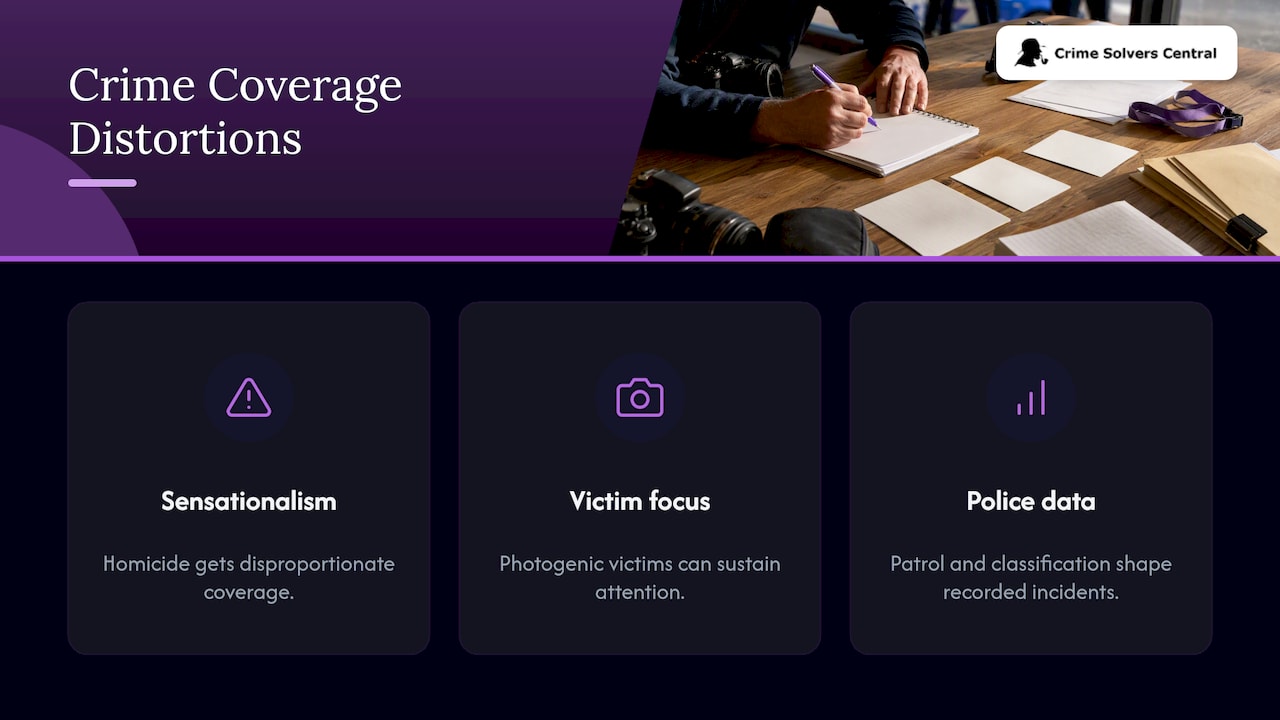
Crime coverage is not a mirror of crime. The Oxford Research Encyclopedia of Criminology notes that U.S. coverage is often disproportionate, concentrating on sensational, serious crimes like homicide, which can distort public perception of actual crime rates. Rare, dramatic events get airtime. Common, quieter ones, such as thefts and many drug cases, get less, and most people’s weekly diet of local news reflects that imbalance.
There is a second skew that matters to our community. Cases that start with a sympathetic, easily photographed victim get sustained attention. Others, including many missing adults, people on the margins and unidentified remains, vanish from the news within days. Policing practices add a third layer: what gets recorded depends on how a department patrols and classifies incidents. Our guide on how policing styles affect crime data explains why two cities with similar real conditions can produce very different statistics.
Practical takeaway: when you read a crime story, ask what is not being covered, and use official data for the big picture.
Following missing-person and cold-case news
For families, crime news is not abstract. A new article can mean a lead; a rumor can mean a setback. The most useful approach is to follow a case through primary channels and treat everything else as a prompt to check.
- Official case pages. The investigating agency’s page is the authoritative record of what is publicly known and how to submit information.
- Local news alerts. Set alerts for the person’s name and the county or city where they were last seen.
- Case databases. A searchable catalog lets you see whether similar cases in the same state share patterns, such as location, timing or vehicle descriptions.
- Verification before sharing. Our piece on recent missing persons cases and verifying before you share covers how to confirm a person is still missing before reposting. Outdated alerts can mislead searchers and distress families.
If a child is missing, speed matters and the route is specific. USAGov lists the National Center for Missing and Exploited Children at 1-800-THE-LOST (1-800-843-5678) for reporting missing children or kidnapping cases within the U.S. For a broader walk-through, see what families and advocates must know about missing children and our practical U.S. guide to finding missing persons.
Sharing information with investigators the right way
Something in the news reminds you of what you saw years ago. What now?
- Is it an emergency? USAGov says emergencies must be reported immediately by dialing 911, while non-emergency reports and anonymous tips go to the relevant local law enforcement agency.
- Is it federal? USAGov lists the FBI’s toll-free number as 1-800-CALLFBI (1-800-225-5324) and says the Bureau investigates terrorism, cybercrime, white-collar crime, public corruption, civil-rights violations and other major crimes.
- Is it a specialized hotline matter? USAGov directs human trafficking concerns to the National Human Trafficking Hotline at 1-888-373-7888, by texting HELP to 233733, or through live chat. For domestic abuse, it lists the National Domestic Violence Hotline at 1-800-799-SAFE (7233), or text START to 88788.
- Write down specifics first. Dates, locations, names, vehicle details, what you saw yourself versus what you heard from others. Keep the two clearly separate.
- Keep your own file. Save original photos and messages without editing. If you plan to submit images, read our guide on stripping EXIF data before sending anonymous tips, which explains what hidden metadata can reveal about you.
For cold cases specifically, we explain the steps in how to report information about a cold case and how anonymity works in our guide to anonymous tip lines.
What not to do: do not confront a suspect, do not publish a name online as an accusation, and do not alter or collect evidence at a scene. Online sleuthing that names the wrong person can harm an innocent individual and damage a prosecution. Our ethical playbook for the true crime community sets out the boundaries we ask every member to follow.
Victims and the justice system in the headlines
Crime stories are also about people who did not choose to be in them. Two facts are worth knowing when a federal case is in the news. First, the Department of Justice notes that the Crime Victims’ Rights Act applies only to victims of counts charged in federal court, and that while victims have the right to retain counsel, neither the government nor the court pays for it. Second, a state case follows state rules, which differ.
When coverage dwells on a suspect’s background and barely names the victim, that is a signal about whose story is being told. Responsible outlets, as NewsLab’s guidance suggests, look at how victims are treated. As a reader, you can reward that by sharing and following reporters who do it well.
Using crime news for study: a guide for students
Crime news is raw material for criminology and sociology coursework, if you treat it as data about coverage as well as data about crime.
- Trace one case end to end. Pick a local case and collect every article from first report to resolution. Note how the framing, sources and tone change as the case moves through court.
- Compare coverage with statistics. Take the type of crime most frequently covered in your area and set it against the numbers from the FBI’s Crime Data Explorer. The gap between what is reported and what is recorded is a classic research question.
- Code the sources. For ten stories, tally how many rely on police statements, court documents, victims’ families or community members. This directly tests the concern about source authority raised by Nieman Lab’s reporting.
- Track the missing. Compare how long a missing-person case stays in the news with the case’s demographic profile. Cold-case databases organized by state and case type make that comparison far easier.
- Cite carefully. Distinguish allegations from findings in your own writing. A paper that treats an indictment as proof will lose marks.
Students get free summaries, news and guides from us; full case files are for members.
Our perspective: crime news needs a second chapter
We built Crime Solvers Central around a simple observation: crime news is excellent at the first week of a case and poor at the next twenty years. A missing person’s story runs, the cycle moves on, and the family is left holding the file.
That is why we maintain a national database of more than 264,000 cold cases, missing persons, unsolved homicides and unidentified or unclaimed remains, organized by state and situation. A reader who sees a headline about a new discovery can look up older cases in the same area and see what is already on record. Families and volunteers can then work from a shared, organized base instead of scattered posts.
We also hold a firm line on process. Allegations stay allegations. Tips go to investigators, not to comment threads. Volunteers support law enforcement rather than replace it. The most valuable thing a member can do is not to solve the case in public, but to organize accurate information so the right person sees it.
— Crime
Work cold cases with us
If the news has led you to a case you cannot stop thinking about, our membership gives you full case files, sources, videos, forums, digital evidence boards, a flyer builder and volunteer coordination. Plans on our pricing page are Jr. Detective at $3.97 per month or $39 per year, Sr. Detective at $9.97 per month or $99 per year, and True Crime Influencer at $39.97 per month or $399 per year. Families who need to get a flyer out quickly can start with our flyer builder, and you can learn more about our mission on the About page.
FAQ
Where can I find the most reliable crime news?
Start with official sources: federal agency press pages such as the FBI’s violent crime news, court dockets, and the FBI’s Crime Data Explorer for statistics. Then compare with local newsrooms and wire services. A story confirmed by an official record and at least one independent outlet is on solid ground.
Does an arrest or indictment mean someone is guilty?
No. The Department of Justice describes an indictment as an allegation and says defendants are presumed innocent until proven guilty. Only a court verdict or a guilty plea establishes guilt, so look for those words in the report.
How do I report something I learned from a news story?
Call 911 if it is an emergency. Otherwise contact the local law enforcement agency handling the case, or the FBI at 1-800-CALLFBI if it is a federal matter. For missing children, NCMEC’s line is 1-800-THE-LOST. Share only what you directly know, and keep opinions out of it.
Why does crime news seem worse than the statistics?
Coverage favors serious, dramatic crimes like homicide, which can distort how common they seem. Check your county’s multi-year numbers in the Crime Data Explorer for a more accurate picture.
Can students use crime news for research?
Yes, as long as they separate allegations from outcomes and compare coverage against official data. Tracing a single case from arrest to sentencing is a strong starting project.
Sources
- Types of local crime news Americans get, and what interests them (Pew Research Center)
- Reporting on Criminal Cases, Journalist’s Guide (U.S. Courts)
- Beat reporting: How to cover crime, cops and courts (NewsLab)
- 10 years after Serial: Nieman Lab looks at crime news now
- Violent crime news (FBI)
- Find crime statistics (USAGov)
- FBI Releases 2025 Reported Crimes in the Nation Statistics
- United States v. Marc Schessel (U.S. Department of Justice)
- Report a crime (USAGov)
- Federal Bureau of Investigation (USAGov)
- Crime News in Newspapers (Oxford Research Encyclopedia of Criminology)