

Cold Cases Solved by DNA: How It Happens and Real Examples
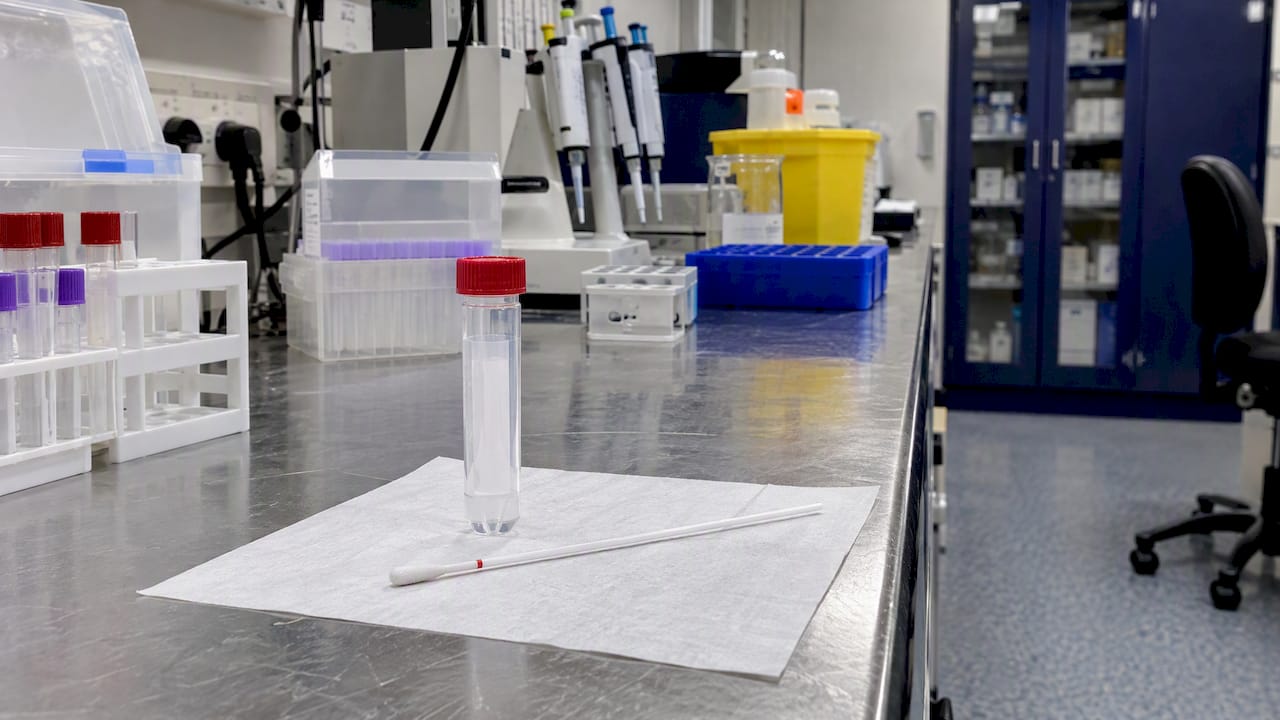
DNA has solved hundreds of U.S. cold cases, but almost never by itself. It works when preserved evidence, a database hit or a family tree, and old-fashioned detective work all line up. Below you will find how the two main methods work, nine documented cases, what the numbers do and do not tell you, and what families and volunteers can do to help a case reach that point.
TL;DR
- Investigators first search a crime-scene profile in CODIS, the national forensic database. When that fails, they may use investigative genetic genealogy (IGG), which finds distant relatives and builds a family tree.
- Solved cases include Fawn Cox (1989), April Tinsley (1988), the Shenandoah National Park murders (1996) and Roxanne Wood (1987).
- A DNA profile does not guarantee a solution. With no database hit and no leads, a case can stay open.
- Official counts vary by program, so be careful with any single “cases solved” figure.
- Families and volunteers can help by organizing facts, confirming details and sending tips to the right agency.
Table of Contents
- What “solved by DNA” actually means
- The two main routes: CODIS and genetic genealogy
- Nine U.S. cold cases solved with DNA
- How many cold cases has DNA solved?
- Why DNA does not solve every cold case
- Legal and privacy limits
- Our perspective: DNA is the end of a long chain
- How families and volunteers can help a case move
- Find your case, and the cases like it
- FAQ
What “solved by DNA” actually means
DNA evidence can identify suspects, link crime scenes to each other, and clear people who were accused or convicted of crimes they did not commit, according to a Congressional Research Service report on DNA in the criminal justice system. The same report notes that investigators can use DNA from hair, bone, teeth, saliva and blood.
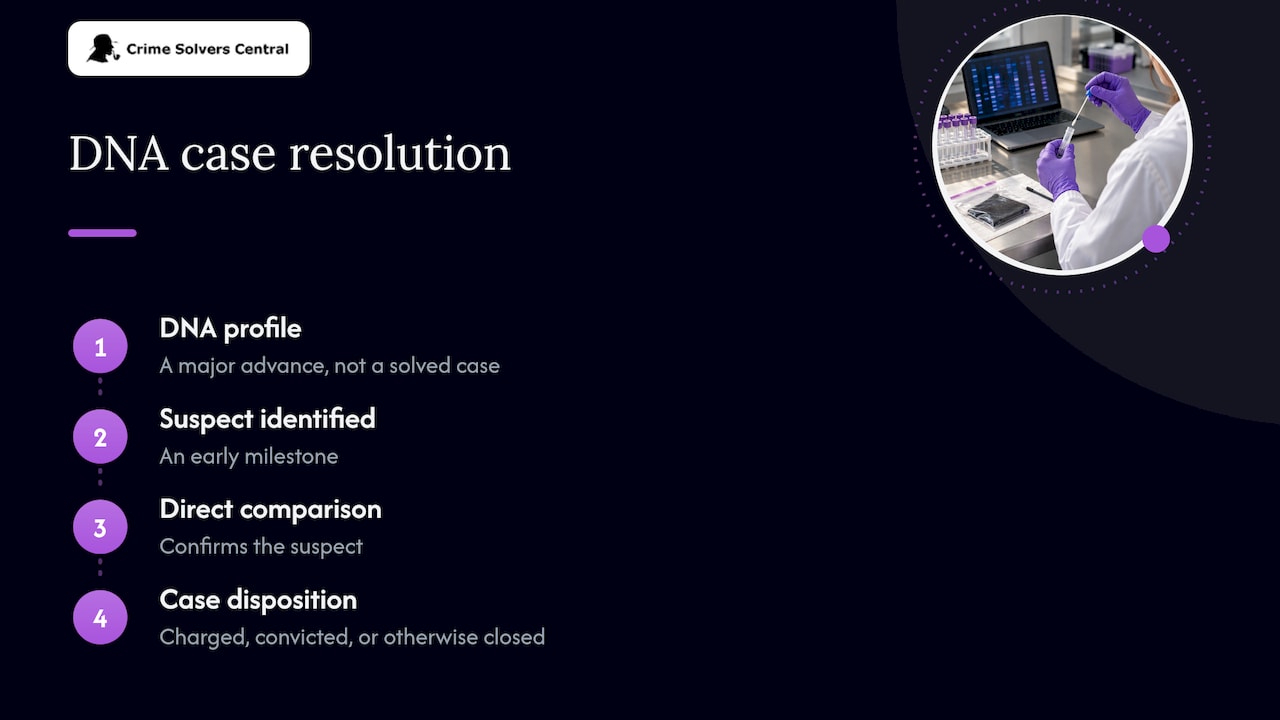
Still, getting a profile is only step one. A 2022 National Institute of Justice (NIJ) article points out that a profile with no hit in available databases does not necessarily solve a case, although producing the profile is a major advance. A case is truly resolved when a suspect is identified, confirmed with a direct comparison, and then charged, convicted or otherwise closed. Sometimes the suspect has already died, and the case is closed by exceptional clearance rather than a trial.
That distinction matters when you read headlines. “DNA identifies suspect” is an early milestone. An arrest, a confession or a conviction comes later.
The two main routes: CODIS and genetic genealogy
CODIS: searching known profiles
The Combined DNA Index System (CODIS) lets laboratories electronically search forensic profiles against offender and other indexes to find links or suspects. The NIJ reports that CODIS, created under the DNA Identification Act of 1994, had aided more than 545,000 investigations since 1998.
A CODIS match is a lead, not a verdict. The FBI explains that a match between forensic and offender indexes is not confirmed automatically. Qualified analysts at the laboratories involved have to contact each other and independently confirm it.
The national index also has privacy limits. The FBI’s 2022 Privacy Impact Assessment states that the National DNA Index System holds DNA profiles but not DNA samples or the names of contributors.
Investigative genetic genealogy: when CODIS comes up empty
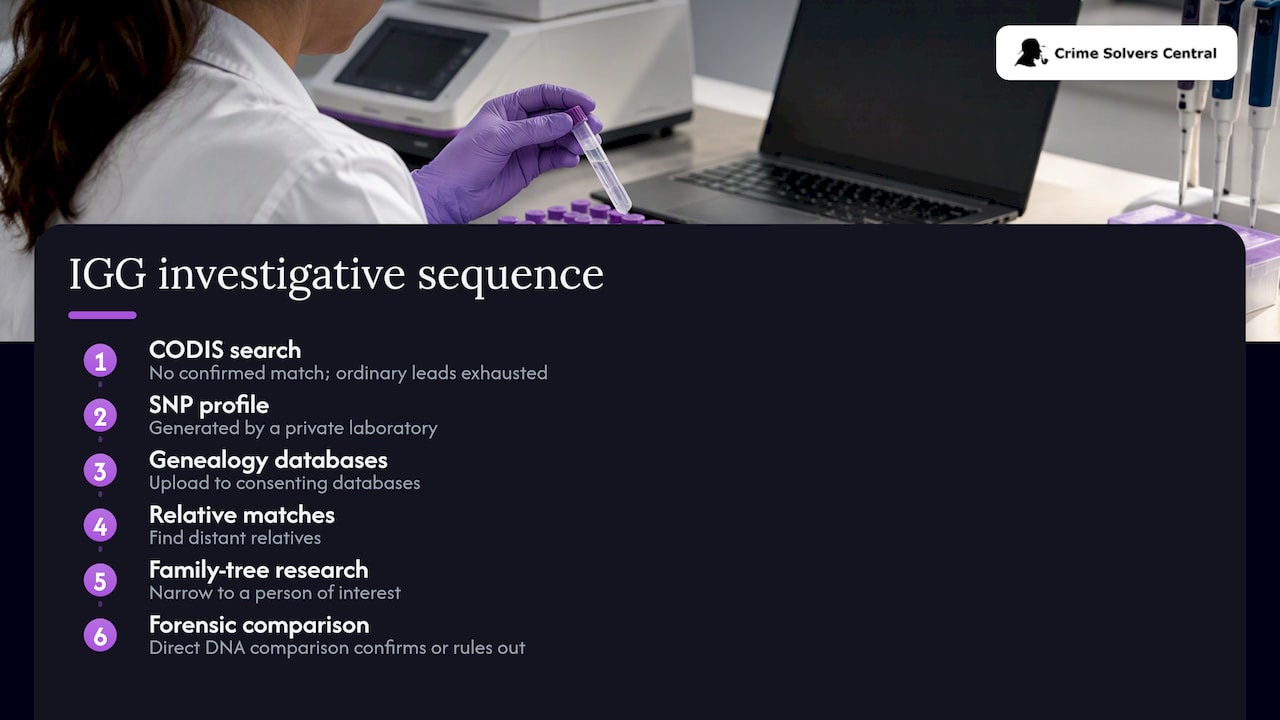
Many cold cases produce a profile that matches no one in CODIS. That is where IGG comes in. As an academic review in the Journal of Law and the Biosciences describes it, investigators search CODIS first, and if there is no confirmed match and ordinary leads are exhausted, agencies may use a SNP profile generated by a private laboratory to find distant relatives in genealogy databases.
The technical difference is scale. A 2022 NIJ podcast explains that CODIS uses roughly 20 markers, while genealogy compares hundreds of thousands of SNPs. That is why it can reach cousins, not just parents and siblings.
The database match is rarely the offender. As BJA’s Angela Williamson explains in a BJA podcast, the process uploads an unknown profile to consenting databases, finds relatives, and then builds a family tree. Genealogists and detectives narrow that tree, and the result is a person of interest. Standard forensic testing then confirms or rules out the person, usually with a direct DNA comparison.
Nine U.S. cold cases solved with DNA
These cases come from police, prosecutors, the FBI and major news outlets. Each shows a different path.
| Case | Year of crime | How DNA helped |
|---|---|---|
| Fawn Cox, Kansas City | 1989 | IGG led to a cousin whose retained sample matched |
| April Tinsley, Indiana | 1988 | Genealogy led to John D. Miller; discarded items matched |
| Shenandoah National Park | 1996 | Private-lab DNA hit in CODIS |
| Shannon Rose Lloyd and Renee Cuevas, Orange County | 1987, 1989 | IGG linked two murders to one man |
| Denver serial killer | Late 1970s to early 1980s | IGG tied four murders to Joe Michael Ervin |
| Roxanne Wood, Michigan | 1987 | Genealogist worked with preserved evidence |
| Yolanda Herrera, Texas | 1981 | Advanced testing plus IGG |
| San Diego (Dennis LePage) | 1975 | Palm print hit, then DNA match |
| San Diego (Kenneth Ford) | 1987 | Fingerprint hit, then DNA comparison |
Fawn Cox, Kansas City (1989)
The crime-scene bodily-fluid profile had no CODIS hit. According to Kansas City police, investigative genetic genealogy in 2020 narrowed the search to Cox’s cousin, and his retained blood sample matched the evidence. He had died in 2006. The department also said genealogy is powerful but limited by cost, protocols and manpower, which is why federal resources and specialized expertise were decisive.
April Tinsley, Indiana (1988)
Genetic genealogy pointed investigators to John D. Miller and his brother in 2018. CNN reported that DNA from Miller’s discarded condoms matched the crime-scene and threatening-message evidence, and that Miller confessed to abducting, raping and killing Tinsley. It is a clear example of how a relative-based lead is still confirmed with the suspect’s own DNA.
Shenandoah National Park (1996)
A new FBI team reviewed the murders of Lollie Winans and Julie Williams in 2021. Per the FBI Richmond field office, a private lab recovered DNA from evidence, CODIS matched it to convicted serial rapist Walter Leo Jackson Sr., and a buccal swab comparison confirmed it. Here, better lab work, not genealogy, was what broke the case. The old evidence simply had not been tested with newer methods.
Shannon Rose Lloyd and Renee Cuevas, Orange County (1987 and 1989)
The Orange County District Attorney reported that IGG identified Reuben J. Smith, who died by suicide in 1999. DNA from his 1998 arrest matched both crime scenes, which also shows why a single suspect can connect separate cases.
Denver’s unknown serial killer
The Denver investigation, discussed in the same BJA podcast, identified Joe Michael Ervin as responsible for four women’s murders in the late 1970s and early 1980s. He had also killed a police officer and died by suicide in jail.
Roxanne Wood, Michigan (1987)
CBS News reported that genetic genealogist Gabriella Vargas worked with preserved crime-scene DNA, and after 34 years the evidence led to Patrick Wayne Gilham, who was arrested and charged. Preservation is the quiet hero in many cases like this one.
Yolanda Herrera, Texas (1981)
The Texas Department of Public Safety says advanced DNA testing and forensic genetic genealogy identified Kelly Lee Brower in 2025. After interviews, Brower confessed, and he was arrested in Arizona in August 2026 for extradition to Texas.
Two San Diego cases solved through prints and DNA
Not every “DNA” case begins with DNA. In a 1975 San Diego case reopened in 2019, latent prints searched in the FBI’s NGI system led to Dennis LePage. His DNA then matched, and he pleaded guilty to first-degree murder in September 2021, according to the FBI’s CJIS Division. In a 1987 killing of a 79-year-old woman, a fingerprint hit identified Kenneth Ford after 31 years, and a warrant-supported DNA comparison matched semen from the victim, per the FBI’s 2021 award record. He received life without parole.
How many cold cases has DNA solved?
There is no single national number, and you should distrust any site that offers one without saying what it counts. Different programs measure different things.
- The NIJ’s Solving Cold Cases with DNA program, established in 2005, had awarded over $73 million to more than 100 agencies, funding review of over 119,000 cases and producing more than 1,400 CODIS hits as of 2014, according to the NIJ. A hit is a lead, not a closed case.
- The Bureau of Justice Assistance’s Prosecuting Cold Cases Using DNA program reported 78 initially unknown suspects identified, 19 convictions and 78 cases resolved or closed as of its April 2024 fact sheet. Thirty of those suspects were identified through forensic genetic genealogy.
- The Department of Justice says IGG was first used to solve the Golden State Killer case in 2018 and that the FBI’s nationwide program had solved more than 300 homicide and sexual-assault cases at the time of its cited page.
Three programs, three definitions: hits, suspects identified, cases closed. Hundreds of additional cases have been solved by local agencies and private partnerships that no federal figure captures, so any total is a floor.
Why DNA does not solve every cold case
DNA is not magic. A few realities keep many cases open:
- No usable evidence. Evidence may have been lost, destroyed or never collected. Samples can also be degraded or too small. Researchers led by Sarah Cavanaugh recommend reviewing case and sample metrics before choosing a genotyping technology, including for low-template or degraded samples.
- No database hit. A profile only helps if there is someone, or a relative of someone, to compare it with.
- Indiscriminate testing is inefficient. A 2012 Office of Justice Programs report found that success from testing large numbers of cold cases without strategy is likely below 50 percent, which is why agencies prioritize cases by solvability.
- Cost and staffing. As the Kansas City example shows, genealogy work takes money and expertise most small agencies lack.
Cook County Sheriff’s Detective Lt. Jason Moran says in the NIJ article that success depends on using modern methods like DNA analysis, prioritizing by solvability, and building partnerships between agencies.
Legal and privacy limits
IGG is not unlimited. The Department of Justice’s interim policy says forensic genetic genealogical searching may be considered for an unsolved violent crime only after reasonable investigative leads have been pursued and CODIS searches have not produced a probative, confirmed match. The databases involved rely on users who have consented to law enforcement matching, and state rules are evolving. A 2023 article on national guidelines notes that Florida exempted genetic genealogy materials from public records disclosure, while Utah passed the Sherry Black Bill.
If your family has submitted a relative’s DNA to a missing-persons effort, ask the agency in writing how the sample will be stored, searched and retained.
Our perspective: DNA is the end of a long chain
We run a database of more than 264,000 cold cases sorted by state and type, and we see the same pattern from the inside. DNA gets the headlines, but the cases that move are usually the ones where somebody kept the file organized. The date of last contact, the clothing, the car, the names of people who were interviewed: when those details are consistent and findable, an agency can decide quickly whether a case is worth sending for testing.
That is why we built our tools around the groundwork. Members use case profiles, digital evidence boards and a flyer builder to keep facts straight, and forums to compare notes with other volunteers. None of that replaces a lab. It helps make sure that when a lab, a genealogist or a detective has a window, the case is ready.
We also think families deserve honesty. A profile in a database is not a promise. Our advice is to pursue three things in parallel: keep pressure on the investigating agency, keep the public aware of the case, and keep your own records clean.
— Crime
How families and volunteers can help a case move
We could not find a single official national checklist, so these steps combine the federal tip guidance with what we see work in practice.
- Identify the investigating agency and the lead detective. Ask whether the case has been reviewed by a cold case unit.
- Ask what evidence still exists. In writing, ask whether biological evidence is preserved and whether it has been tested with current methods.
- Send tips to the right place. For federal matters, the FBI says you can submit a tip online at tips.fbi.gov, contact your local field office, or call 1-800-CALL-FBI. For a local homicide, start with the local police or sheriff, and use any tip line they list.
- Give verifiable details only. Dates, places, names you can source. Leave speculation out, and never confront a suspect yourself.
- Keep a timeline. One document, one version, updated when something changes.
- Know the limits of volunteer work. Volunteers help most by organizing facts, raising awareness and passing tips on, never by investigating independently. Our guide on helping solve cold cases safely covers this in detail, and our piece on collaborating with communities on unsolved crimes explains how to work with local groups.
For more background, see our guides on the role of DNA in cold cases, famous cold cases and unsolved homicides.
Find your case, and the cases like it
The fastest way to see whether a case you care about is already documented is to browse the cold case database by state. Free summaries show the basics. Members unlock full case details, sources, videos, forums, digital evidence boards, the flyer builder and volunteer coordination tools.
Our membership plans are published as follows:
| Plan | Monthly | Yearly |
|---|---|---|
| Jr. Detective | $3.97 | $39 |
| Sr. Detective | $9.97 | $99 |
| True Crime Influencer | $39.97 | $399 |
If you want to understand how a national database can be used strategically, start with how to leverage national database cold cases. You can also read about why cold case databases matter for justice.
FAQ
Do cold cases get solved with DNA?
Yes. Federal programs and local agencies have identified suspects and closed cases using CODIS hits and genetic genealogy. Success depends on whether biological evidence survived, whether it can produce a profile, and whether that profile leads to a person. Many cases still remain open.
How is a DNA match different from a solved case?
A match is a lead that must be independently confirmed. The FBI says CODIS matches require analysts at the laboratories involved to confirm them. After that, prosecutors decide whether to charge, or the case may be closed if the suspect has died.
Who can use genetic genealogy to solve a crime?
Law enforcement agencies, usually working with a specialized lab and genealogist. The Department of Justice’s interim policy says it should be considered for unsolved violent crimes after standard leads and CODIS searches have failed. Families cannot run these searches themselves, but they can ask the investigating agency whether the option has been considered.
Can I help with a cold case if I am not law enforcement?
Yes, in safe ways. You can organize case facts, help spread the word, and pass verified information to the investigating agency or an official tip line. Leave interviews, confrontations and evidence handling to investigators.